44 Milano Profile - Marcello Maloberti
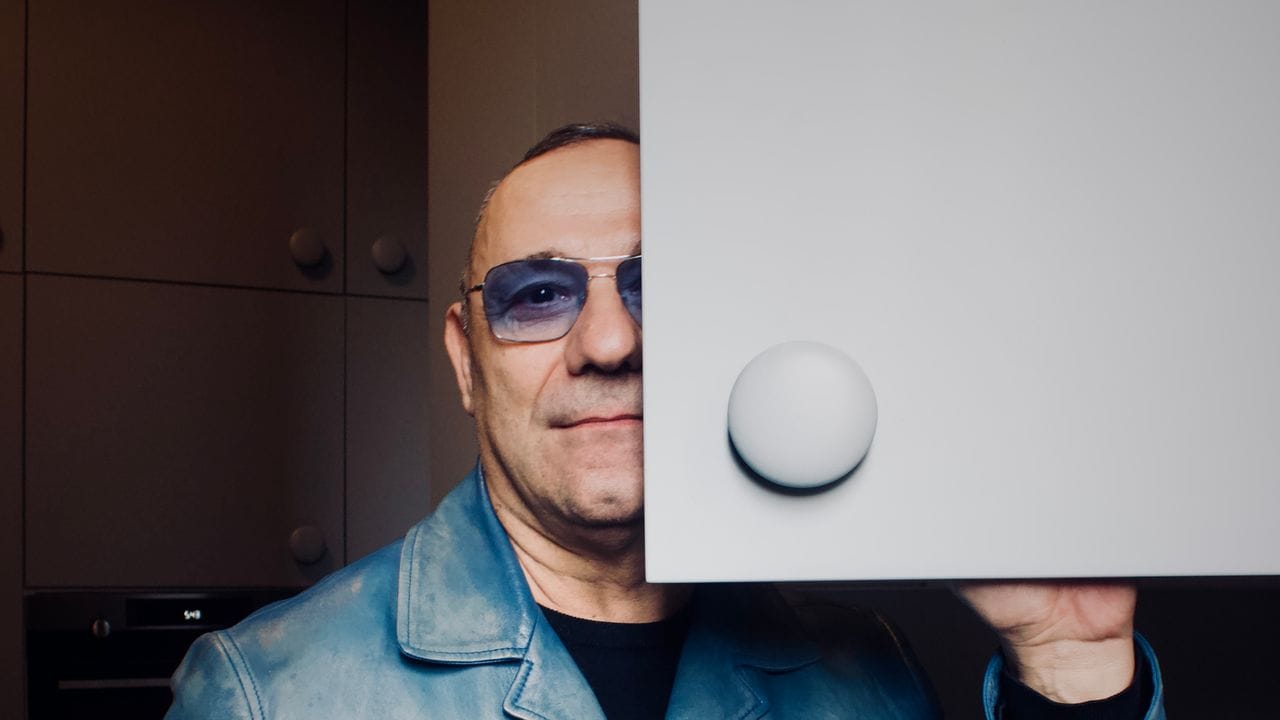
“The beautiful thing about artists is that they live within their own solitude.” Photos and Q&A by Domenica Bucalo.
Reported by Vogue.
There's a particular kind of artist who refuses to be filed away neatly — no singular medium, no tidy studio practice, no clean boundary between the work and the life producing it. Marcello Maloberti is exactly that kind of artist. One of contemporary Italian art's most singular voices, Maloberti is perhaps best known for his MARTELLATE — compressed, almost violent phrases that function less like captions and more like detonations. Artists are always hungry. Ecstasy has not to be designed. Praise be to unconscious beauty. According to Vogue, these terse declarations have become a defining signature of his practice.
The origin story is almost too perfect: as a child, Maloberti stumbled across Caravaggio's La Conversione di San Paolo while flipping through a book on his mother's bed. The shadow, the stillness of the horse, Saint Paul prostrate with arms open — he felt the image belonged to him. He still does. That single encounter, he says, set everything in motion. It's the kind of formative moment that sounds mythologized until you see how completely it explains everything that followed: an artist obsessed with vision, with the body in space, with light as a force that reorganizes reality.
The Studio Is a State of Mind
Maloberti doesn't have a traditional studio — he has a home-studio, a deliberate refusal to separate living from making. He cites philosopher Emanuele Dattilo's concept of pantheism as something close to his own method: not a division between self and world, but a continuous crossing through both. His multimedia practice — spanning performance, installation, neon, sound — isn't restlessness for its own sake. Every medium, he argues, opens a different emotional door. He's never worked toward closed form; the point is always to break it apart. His reference point is Giacometti, who famously didn't finish works so much as abandon them. Maloberti gets it.
His newest piece, ECHO, is a neon installation created for WAVES, a collateral exhibition at the 2026 Venice Biennale, curated by Sergio Risaliti and Cristiano Seganfreddo and staged at Casa Sanlorenzo. Positioned on a bridge near the Basilica of Santa Maria della Salute, the reversed word hovers above canal water that slowly swallows its reflection — a direct pull from Ovid's myth of Echo and Narcissus, two figures who never truly meet, endlessly pursuing each other across the space between word and image. In Venice, a city built on echo and threshold, the choice is less concept than inevitability. The bridge, he notes, isn't a connection — it's a suspension between two worlds.
What Maloberti ultimately makes is an argument: that beauty doesn't need to be planned, that the peripheral holds more magic than the center ever will, that a dance floor — like his traveling installation CIRCUS, with its tent and suspended mirrors and ricocheting headlights — is always a device for suspending reality and returning it altered. When fashion and art talk about "feeling something," this is what they mean, whether or not they know it.
The work that endures is the work that stays open — and Maloberti has built an entire practice around refusing to close it.
Read the original at Vogue.