Anok Yai Looked Met Gala-Ready at the Time100 Gala
In her sculptural Ashi Studio dress, Anok Yai furthers the case that fashion is, indeed, art.
Reported by Vogue.
Anok Yai just proved that the red carpet hierarchy extends beyond a single night. The model landed a spot on Time's 100 most influential people list—joining Hailey Bieber and Dakota Johnson—and marked the occasion with a strategic wardrobe move: two outfit changes that telegraphed something bigger than the gala itself.
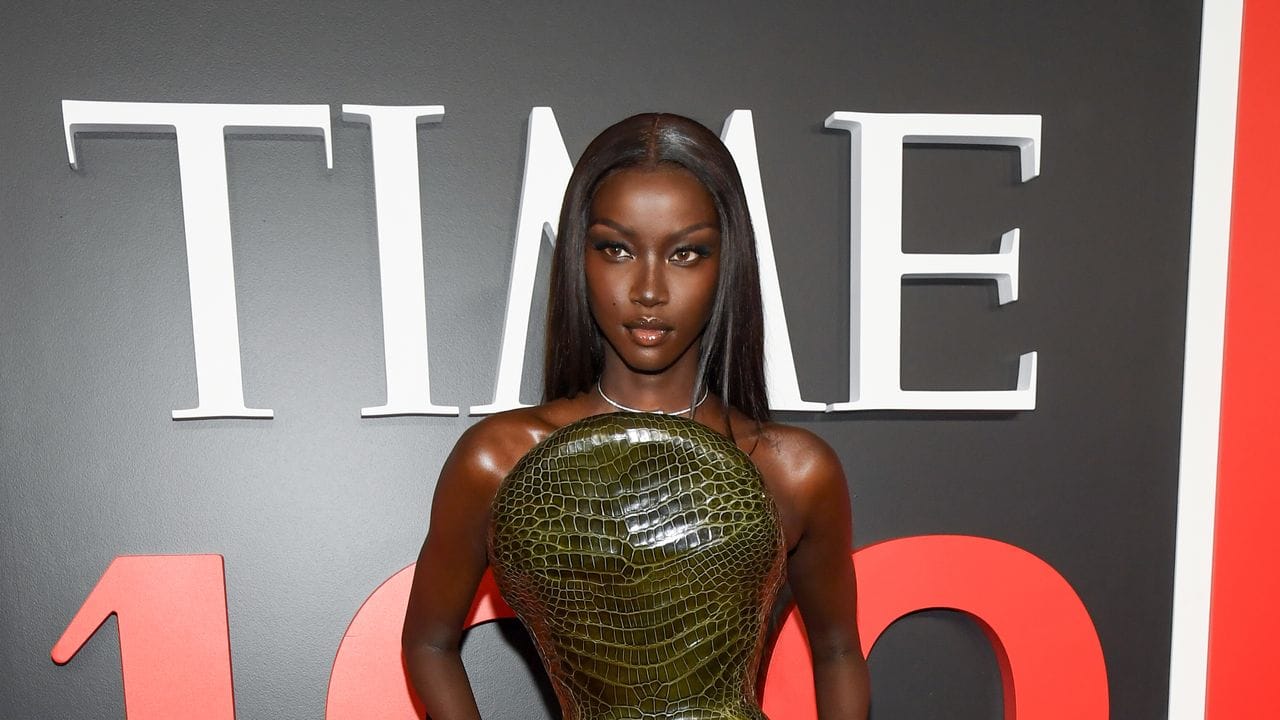
She arrived at Lincoln Center in an indigo Hervé Léger bandage dress, all body-con minimalism and restraint. Then came the pivot. For the actual red carpet, Yai switched into a green croc-embossed midi from Ashi Studio's spring 2026 couture collection—the kind of architectural statement piece that stops conversations. The dress had all the bells: an inverted strapless neckline, a sculptural bodice engineered around a nipped waist and padded hips, a flared skirt that moved like it had a mind of its own. She paired it with matching pointy-toe croc heels and Marli jewelry, the whole thing dialed up to ten.
The Met Gala Blueprint
Here's where it gets interesting: that second dress felt almost overqualified for the Time100 Gala, where most guests played it safe with classic gowns. But it was perfectly calibrated for something else entirely—the 2026 Met Gala, where the Costume Institute's upcoming exhibition, Costume Art, will position fashion as a legitimate art form, equivalent to painting or sculpture. According to Vogue, Yai's sculptural Ashi Studio moment wasn't just a flex; it was a statement about what fashion can be when it stops apologizing for its ambition.
The dress itself functions as sculpture: padded, intentional, unapologetic about its own dimensionality. It refuses to hang passively on the body. Instead, it constructs the body, molds it, demands space. That's not decoration—that's art operating within wearable form. In an era where fashion is constantly interrogated for its cultural relevance, Yai wearing something this deliberately architectural to a night celebrating influence sends a clear message: fashion isn't decoration for influential people. Fashion is the influence.
The double change strategy matters too. It signals intention, planning, a recognition that different moments deserve different languages. Yai didn't just show up looking good—she demonstrated that she understands the grammar of fashion as communication, which might be the most influential thing she wore all night.
Read the original at Vogue.