<b><strong>Graduating Mascots Share What It’s Really Like to Suit Up in Secret for Their Colleges</strong></b>
“It’s almost Hannah Montana-esque.”
Reported by Women's Health Magazine.
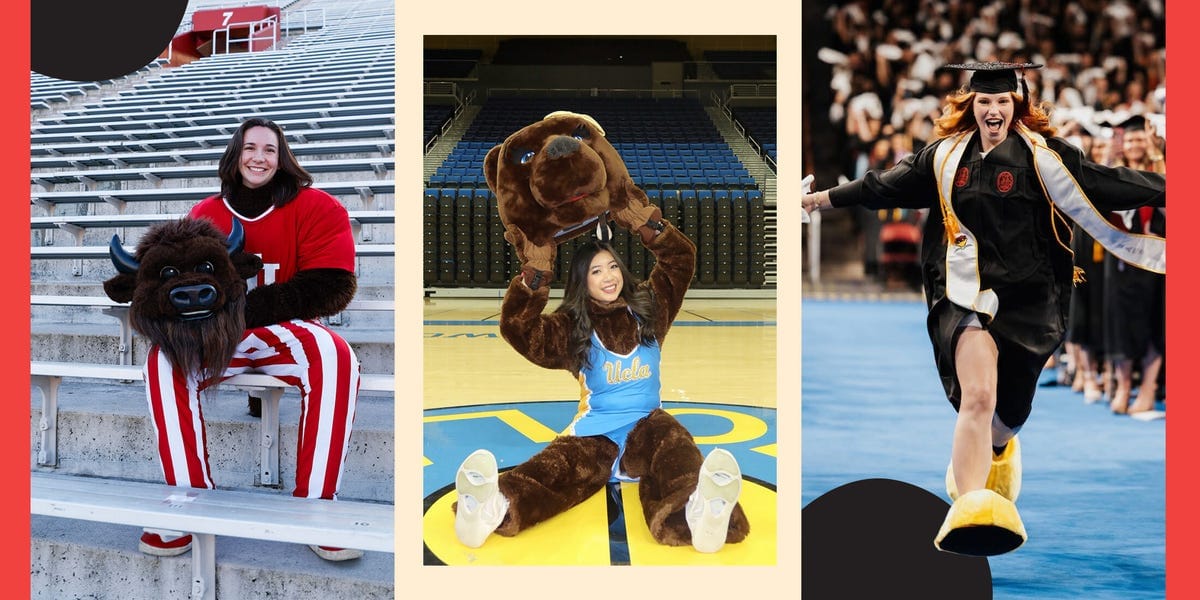
The coolest job on campus comes with one major catch: you can't tell anyone you have it. College mascots perform in front of thousands, rub elbows with famous alumni, and get prime access to some of the biggest moments in collegiate sports — all while keeping their identity completely under wraps until graduation day. And according to Women's Health Magazine, a growing number of the people inside those suits are women.
The logistics alone are a full-time commitment. Emma Connelly, 22, one of three graduating mascots at the University of South Carolina — and the only woman — describes the double life as "almost Hannah Montana-esque." Abbey Armstrong, 23, logged 15 to 20 hours a week suiting up as Indiana University's brand-new mascot Hoosier (the school's first in nearly 60 years), on top of completing her master's degree. Allison Reid, 22, suited up as Hofstra's lioness Kate 20 to 25 times per week while competing on Division I track and cross country. Meileen Taw, 22, spent roughly 15 hours weekly as UCLA's Josie — balancing classes, a job, and club involvement — in a costume that left her with almost zero peripheral vision. "If a little kid comes up to you, it's really hard to see them," she says. The workaround: get down on your knees.
Sweat, Secrets, and a Whole Lot of Strength
Nobody warned them about the acne. Armstrong says her skin took a serious hit from hours inside the suit — a relatable side effect when you consider that a single football game can run 12 hours. The physical demands are no joke either: Armstrong's team ran "arm farm" sessions, a high-volume upper-body circuit targeting biceps, triceps, and forearms. Reid had to completely relearn her movement after Kate's costume was redesigned mid-tenure to be more muscular — and significantly heavier — limiting how high she could even raise her arms. The secret-keeping required its own kind of stamina. Connelly smuggled her costume out to her car at 4 a.m. Armstrong's cover story was simple: she worked in sports marketing. It held up, she says, largely because nobody assumed Hoosier could be a woman in the first place.
That assumption is exactly what graduating mascots are dismantling in real time. Reveal videos are racking up over a million views on social media, with the most viral posts coming from women. The reactions have been mostly enthusiastic — but not without a side of casual sexism. "People will be like, 'I can't believe that was a girl in there running around in that heavy suit,'" Connelly says. "Well, yeah, it was. Why would it not be?" Since her reveal, she's been flooded with messages from women who didn't even know they could try out. Armstrong frames it plainly: "I don't think people were talking about women mascots as much until now, and I've always been in the business of trying to promote women in the athletic landscape."
The women in the suits already knew what they were capable of — now everyone else is catching up.
Read the original at Women's Health Magazine.