Beyond Body-Con: In the the Met’s Spectacular New Exhibition, “Costume Art,” the Human Form Connects Fashion and Art
A first look at the Costume Institute’s debut show in the new Condé M. Nast Galleries.
Reported by Vogue.
The Met's newest exhibition isn't asking you to observe fashion from a respectful distance. It's asking you to see yourself in it — literally. Sculptor Samar Hejazi's faceless, reflective mannequin heads mirror your own face back at you as you move through the galleries, a deliberate provocation from curator Andrew Bolton designed, in his words, "to reflect on your own lived experience, hopefully to create a connection, empathy, compassion towards each other." It's an effect that no algorithm can replicate, and in 2025, that feels pointed.
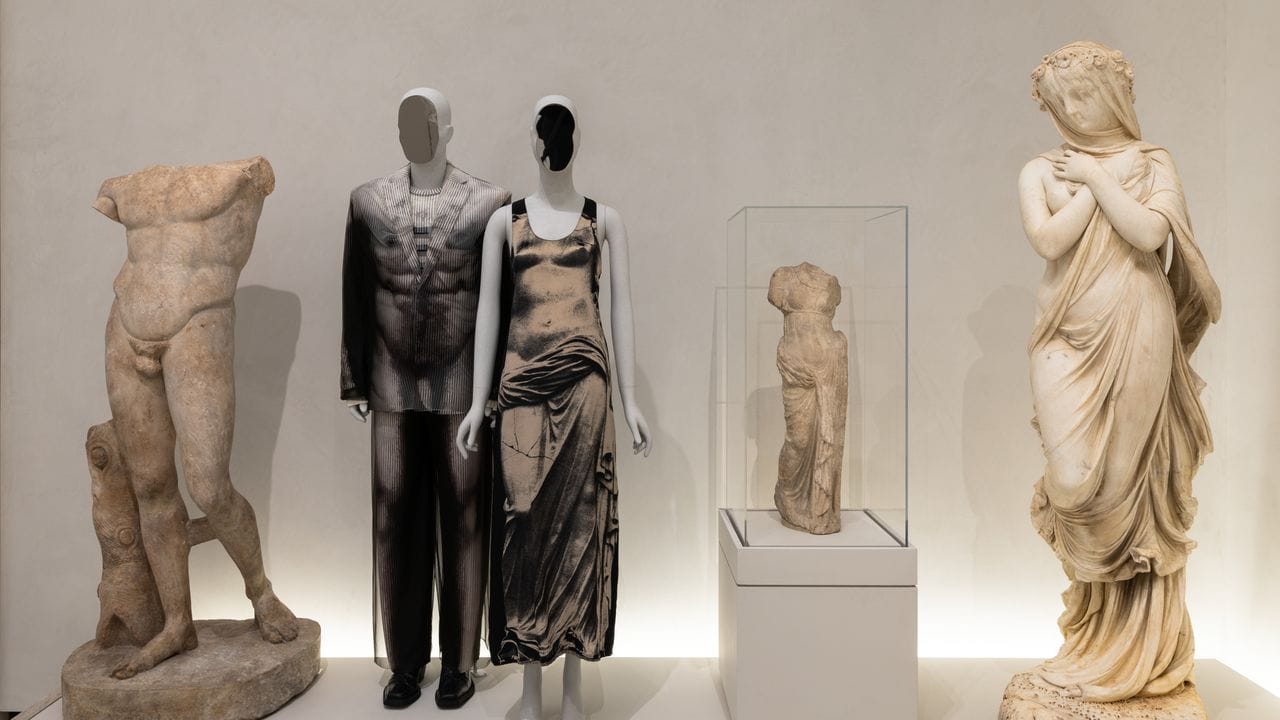
According to Vogue, Bolton — the architect of 2016's "Manus x Machina" — is once again ahead of the cultural conversation, this time planting a flag for physicality and dimensionality at a moment when both feel under threat. The thesis of "Costume Art" is deceptively simple: the dressed body is the connective tissue running through the entire Met collection. What makes it radical is execution. Mannequins modeled after named individuals with diverse body types stand alongside paintings and Grecian urns, Greek goddess draping by Madame Grès and Fortuny, and Rudi Gernreich's breast-baring 1964 monokini. The dressed body isn't a supporting character here — it's the lens through which all other art gets read.
From the Basement to the Great Hall
The Costume Institute's move into the new permanent Condé M. Nast Galleries — just off the Met's Great Hall — is its own kind of statement. For decades, fashion exhibitions have occupied the institutional basement, a physical metaphor that Bolton addresses head-on. "There's always been an inherent sexism around fashion as a discipline," he said, tied directly to the body, to femininity, to the persistent dismissal of clothing as "decorative or illustrative or supplemental." Three of the Met's five most-attended exhibitions ever were Costume Institute shows — "Heavenly Bodies" in 2018 holds the all-time record — so the argument that fashion is a lesser draw was always thin. The new permanent home makes the case architecturally.
The exhibition moves through what Bolton calls body typologies: the Naked Body, the Classical Body, the Abstract Body, the Pregnant Body, the Disabled Body. Each section pairs garments with fine art without subordinating one to the other. A Vivienne Westwood skin-tone legging hangs near a 1504 Dürer engraving of Adam and Eve. A Seurat study for A Sunday on La Grande Jatte — featuring a woman with a bustle so exaggerated it reads as architectural — anchors a section on how corsets, hoops, and foundation garments literally reshaped women's bodies to fit shifting ideals of beauty. Scholar Llewellyn Negrin's catalog essay makes the feedback loop explicit: mannequin proportions dictate garment sizes, which reinforce which body types get to be seen as the standard. Bolton's mannequins, modeled on real, named people, interrupt that loop directly.
"Costume Art" isn't making fashion safe for high art — it's arguing that the hierarchy was always the problem, and that the body, dressed and undressed, is where culture has been negotiated all along.
Read the original at Vogue.