Can Paul Rudd Outsing Nick Jonas?
The unlikely duo star in Power Ballad, out on May 29th
Reported by Harper's Bazaar.
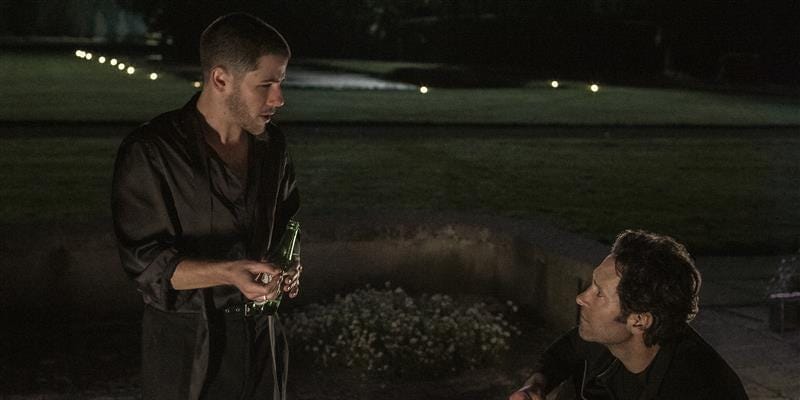
There's a particular brand of humiliation that comes with watching your life's work get stolen—especially when it's soundtracking someone else's ascent. In director John Carney's upcoming film Power Ballad, Paul Rudd experiences exactly that. He plays Rick, a wedding circuit lifer who befriends Danny (Nick Jonas), a washed-up ex-boy band member trying to rebuild his credibility. The twist: Danny appropriates one of Rick's songs, turns it into a chart-climbing hit, and leaves Rick scrambling to prove he wrote it in the first place.
What could be a straightforward revenge narrative instead becomes something more interesting. The film positions itself as a meditation on ambition, artistic integrity, and the complex kinship between two musicians at opposite ends of their careers—one clinging to relevance, one desperate to escape it. When Rick hears his own lyrics blasting through a mall speaker with Jonas's voice attached, the panic isn't just professional; it's existential. The song—"Every song I ever wrote in my life is about you"—becomes the contested territory between them.
A Musician's Pedigree vs. Playing One on TV
Carney, the mastermind behind musical films including the Oscar-winning Once, Begin Again, and Sing Street, knows how to build genuine emotional stakes around music. According to Harper's Bazaar, Jonas brings actual musical credibility to the role. Before The Jonas Brothers made him a household name, he was acting—he played Tiny Tim at seven and continued performing in stage productions even during the height of the band's fame. His filmography spans The Good Half and the recent Jumanji franchise.
Rudd, by contrast, is theater kid energy. He played guitar in I Love You, Man and delivered that unforgettable air piano riff on Friends, but in interviews he's been refreshingly candid: "I play guitar like actors play guitar, which is annoying." That self-awareness—the admission that he's essentially faking it—makes the central conflict all the more delicious. He's not pretending to be a real musician; he's playing someone pretending to be one, and then getting played by someone who actually is.
The film arrives next month, and what emerges is less a showdown than a reckoning: about who deserves recognition, what we owe to our younger selves, and whether a good song matters more than who's singing it.
Read the original at Harper's Bazaar.