Connor Storrie Mixes the Masculine and the Feminine So Damn Well
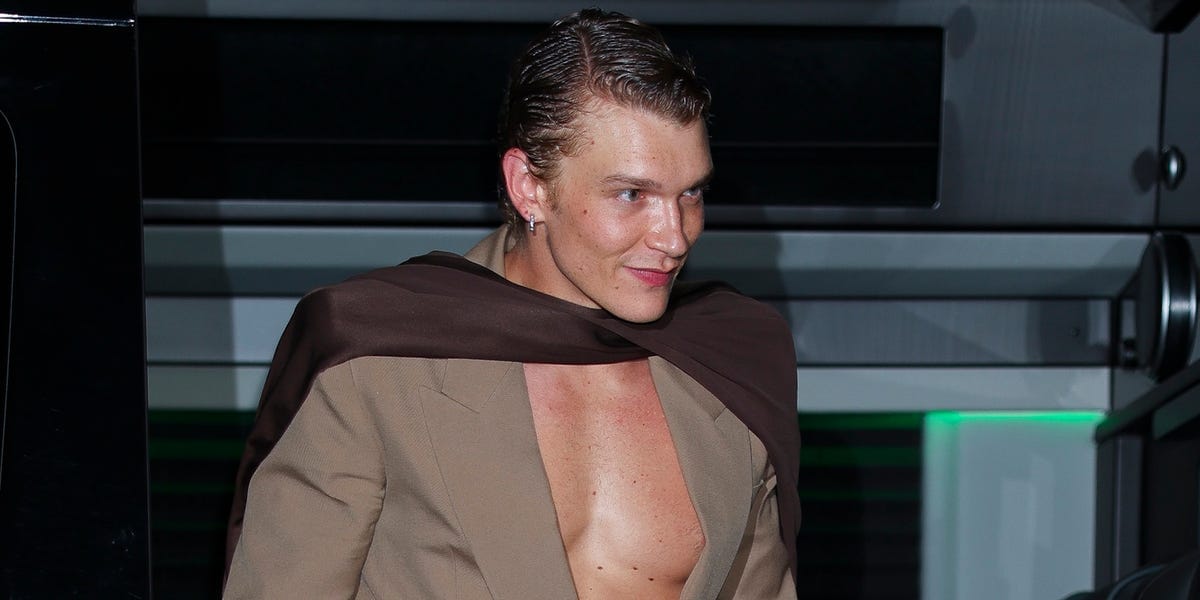
His Met Gala after-party look included a plunging blazer and a silky chocolate scarf
Reported by Harper's Bazaar.
Connor Storrie arrived at his first Met Gala like someone who had attended a hundred times before — completely unbothered, completely dressed, and completely stealing the moment from people who've been doing this for years. According to Harper's Bazaar, the Heated Rivalry star worked the beige carpet in a slouchy black wrap suit from Saint Laurent, anchored by a polka-dot halter top that pooled into a long train and finished with white-gold-and-ruby Tiffany & Co. brooches. At some point on those steps, the jacket came off. Arms out, train trailing, halter gleaming. First Met Gala. Absolutely no nerves.
The After-Party Was a Whole Other Argument
Storrie didn't coast on his carpet moment — he showed up to Saint Laurent's after-party in an entirely new look that made a different, more pointed case. A sandy-toned suit with a blazer cut to a neckline that plunged straight to his navel, worn without a shirt beneath it. Matching tan trousers, glossy brown shoes, a silky chocolate-brown scarf wrapped at the neck and left to trail behind him like a second train. The black leather clutch and kinky diamond hoop earrings weren't afterthoughts — they were the punctuation.
What Storrie is doing, across both looks, is something a lot of men in fashion attempt and almost none pull off: the balance between hard structure and fluid softness, between suiting and something that moves and flows and decorates. The halter tops, the trailing scarves, the brooches — these aren't styled-in quirks. They're the whole point. The masculine frame exists to set off the feminine details, and vice versa. Neither side apologizes for the other.
The hair, for the record: his cherub curls, slicked down for the after-party. Even that was a considered choice — softening the face while the suit did the heavy lifting below.
There's a masterclass buried in these two looks, and Storrie taught it without a syllabus: when you commit to contrast — really commit, not just add one interesting accessory and call it done — the result stops reading as an experiment and starts reading as a point of view.
Read the original at Harper's Bazaar.