Egypt Is A Bucket-List Trip: Our Editor's Guide To Making The Most Of It
Considered a bucket-list trip, our editor spent a week traveling through Egypt on horseback—here's everything she did and thinks you should do too.
Reported by MindBodyGreen.
Egypt has lived rent-free in the collective imagination since elementary school — hieroglyphics on textbook covers, pyramids in documentaries, Cleopatra in every Halloween costume aisle. The mental image is vivid, but it still doesn't prepare you for the real thing. According to MindBodyGreen, a nine-day trip through Cairo and Luxor confirms what skeptics quietly wonder: yes, it absolutely lives up to the hype — and then some.
Cairo First, Then Go South
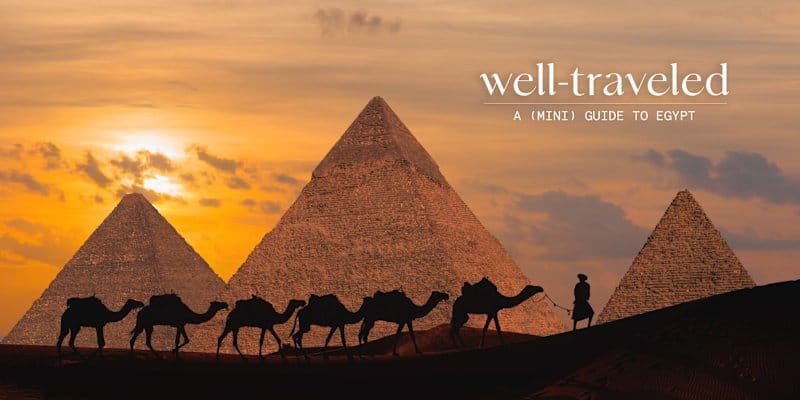
Most Egypt itineraries open in Cairo, and for good reason. The Giza Plateau alone — home to the Great Pyramid of Khufu, the Pyramid of Khafre, the Pyramid of Menkaure, and the Great Sphinx — is a full sensory recalibration. No photograph communicates the scale. If you have extra days, push out to Saqqara, roughly an hour outside the city, where the Step Pyramid of Djoser (built over 4,500 years ago) sits among quieter crowds and hieroglyphics still traced in red and blue pigment. Dahshur — often overlooked — houses the Red Pyramid and the Bent Pyramid, both of which you can physically enter via a narrow descending tunnel that opens into ancient chambers. It's the kind of experience that rewires your sense of time. The Egyptian Museum rounds out Cairo with over 100,000 artifacts, including the gold funerary mask and full treasure collection of Tutankhamun — though plan accordingly, because you could spend an entire day here or a carefully guided few hours.
Once you've absorbed the chaos and grandeur of Cairo, Luxor — situated along the Nile in southern Egypt — hits differently. Slower, more open, and arguably more emotionally affecting. The Valley of the Kings on the West Bank is larger than most visitors expect: tombs carved into desert hills, painted floor-to-ceiling with hieroglyphics designed to usher pharaohs into the afterlife. Some require separate entry tickets, so doing advance research pays off. The Temple of Hatshepsut, built for ancient Egypt's most prominent female pharaoh, delivers towering colonnades and relief carvings that document her reign with the kind of specificity that makes history feel urgent rather than distant. For something less crowded and more quietly spectacular, the Ramesseum — the mortuary temple of Ramses II — offers massive columns, fallen statues, and open courtyards with almost no one else around. A near-private tour of a 3,000-year-old complex is not something you forget.
Practical notes worth keeping: let your guide or travel operator handle hotel bookings — they know the safest and most strategically located options in each area. Budget at least three days in Cairo and three or more in Luxor; the sites reward time rather than rushing. The new Grand Egyptian Museum opened in November 2025 for those planning ahead.
The real gift Egypt offers isn't just history — it's the visceral, humbling experience of standing inside structures that have outlasted every empire since — and that kind of awe is genuinely good for you.
Read the original at MindBodyGreen.