<em>Backrooms </em>Ending Explained—We Fashion Our Own Nightmares
In Kane Parsons’s Backrooms, stars Renate Reinsve and Chiwetel Ejiofor explore the dark corners of their minds
Reported by Harper's Bazaar.
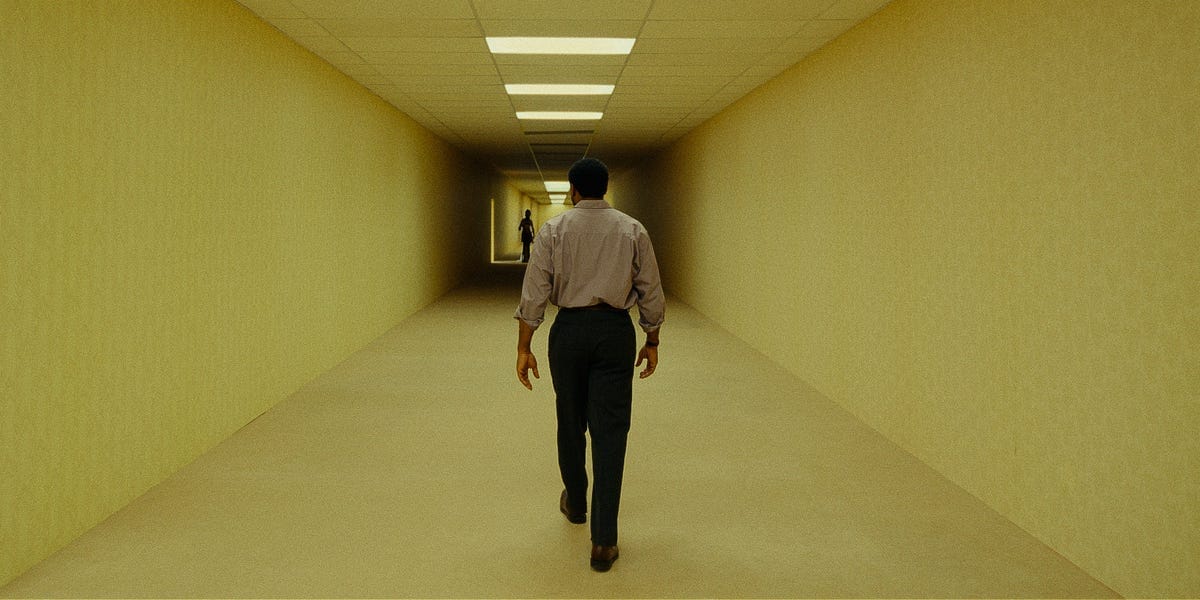
There's a specific kind of dread that has nothing to do with jump scares or gore — it's the creeping suspicion that the worst thing in the room is you. That's the psychological engine behind Backrooms, A24's biggest opening weekend ever, directed by Kane Parsons, who was 16 when he first adapted the concept for YouTube and is now 20, somehow already working with Chiwetel Ejiofor and Renate Reinsve. The film draws from a piece of internet mythology that began with a single off-kilter photo posted to 4chan in 2019 — a yellowed, fluorescent-lit room that looked like the world had clocked out and forgotten to come back. Pandemic-era mass abandonment of offices and public life gave the concept unexpected cultural gravity, and Parsons turned that unease into something cinematic.
The Architecture of Avoidance
The film's protagonist, Clark (Ejiofor), is a collapsed man — failed architect, furniture store owner, estranged husband, part-time pirate mascot in his own commercials, sleeping on a showroom bed because he has nowhere else to go. He stumbles into the Backrooms through a hairline crack in his store's basement wall and finds an infinite labyrinthine office space populated by grotesque amalgamations of his own inventory. His therapist, Dr. Mary Kline (Reinsve), is the only one who takes his frantic hand-drawn maps even remotely seriously. According to Harper's Bazaar, Reinsve has spoken about how Parsons conceived of these spaces as psychological constructions — environments that form themselves from whatever the person entering them is carrying. Clark is carrying a lot.
The monster Clark eventually encounters isn't some external creature. It's a colossal, mutated version of himself in his own pirate costume — his humiliation made flesh, his self-pity given teeth. Parsons described the Backrooms as "a feedback loop of his interior world, vomited out onto the walls." The moment Mary forces Clark to actually reckon with his role in the dissolution of his marriage, the monster charges. He can't survive his own accountability. He fashioned the thing that destroyed him.
Mary survives — barely — fending off Clark's monster with a concrete fragment from her childhood home before being extracted by hazmat-suited researchers from a company called Async, which has been quietly studying the Backrooms all along. But surviving doesn't mean escaping. The film closes on her, now in Async's custody, clearly destined to go back in. We get glimpses of what the Backrooms would look like shaped by her psychology — rooms distorted by an agoraphobic mother's anxiety, fear woven into the wallpaper of her memory. Her monster is still forming.
What makes Backrooms genuinely unsettling isn't the creature design or even the found-footage sequences — it's the implication that self-deception is the most dangerous architecture we build. The film argues that repression doesn't disappear; it just redecorates. Whatever you refuse to look at directly will eventually fill an entire room and come for you, and the scariest thing you can bring into the Backrooms is an unexamined version of yourself.
Read the original at Harper's Bazaar.