I Ran My Best Marathon After My Worst Training Block. Here’s How.
It’s called adaptability in action, people.
Reported by Women's Health Magazine.
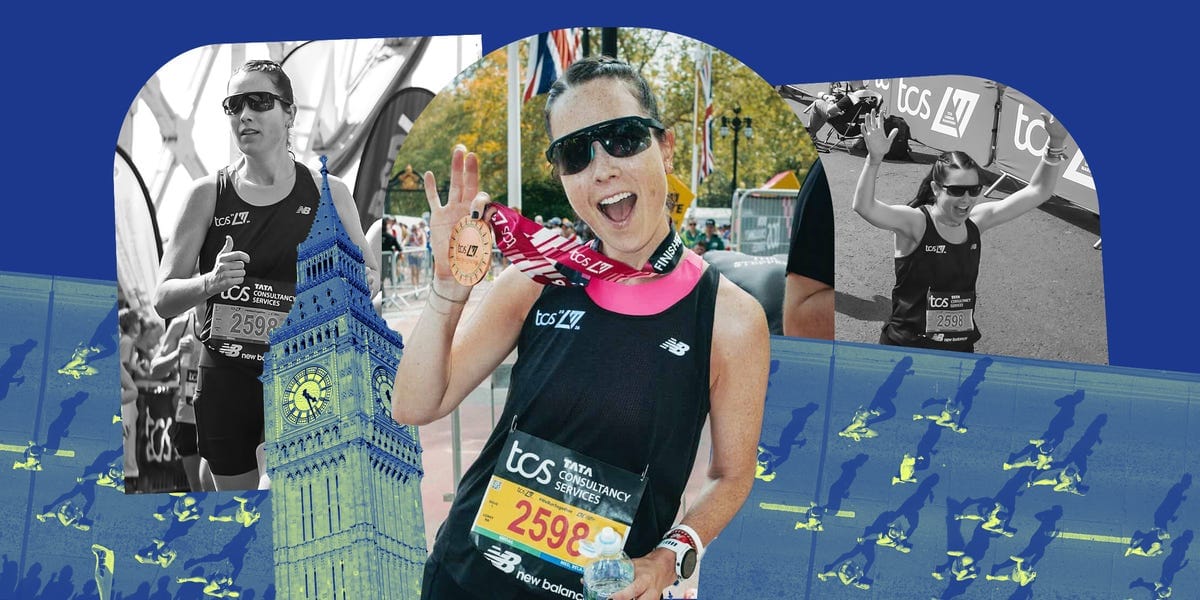
The training block was, by any objective measure, a disaster. Brutal Northeast winters. A flu that left her lungs feeling waterlogged. A family trip through mountains and jungle with nowhere to run. A 22-mile long run that ended with a skinned knee and approximately zero dignity left on a concrete sidewalk. And yet — 3:56. A sub-4 marathon. Her first one, after those 38 agonizing seconds at the 2025 NYC Marathon had been haunting her ever since.
According to Women's Health Magazine, the runner — who crossed London's finish line with Buckingham Palace behind her — credits the chaos itself. Her coach, Linda Leigh LoRe, kept recalibrating the programming and reminding her that no training block is ever perfect. But it was sport psychologist Hillary Cauthen, PsyD — clinical sport psychologist, certified mental performance consultant, and president of the Association for Applied Sport Psychology — who gave the science a name: stress inoculation. "We often think that peak performance comes from perfect preparation," Cauthen explains. "But it's much better with adaptability, not perfection. These less-than-perfect training blocks actually create more mental flexibility, which is huge, especially for endurance athletes." When your body has already learned to navigate discomfort in training, race-day suffering doesn't become a crisis — it just becomes another thing you already know how to move through.
The Case for Deliberate Chaos
Cauthen is so convinced of this that she deliberately engineers disruption for her athletes — from youth to professionals — through what she calls a "chaos day." Mid-drill rule changes. Scrimmage scoring flipped without warning. Anything that forces athletes to regulate their mental response to an unstable environment while they're still safe. The goal isn't to make training harder for the sake of it; it's to build the kind of adaptability that doesn't crack under pressure when the stakes are real. London's 2026 race, which broke a Guinness World Record with 59,830 finishers and already has over 1.3 million applicants in the 2027 lottery, is not exactly a low-stakes environment.
There's also something Cauthen identified as a quieter, unexpected gift of a rough training block: the absence of pressure. Showing up to a start line thinking let's just see what happens is, it turns out, a form of reframing. "The race itself became more of a challenge than a threat," Cauthen told her. When the expectation of a perfect performance dissolves, what's left is presence — running the Tower Bridge at mile 12, feeling strong at mile 14, knowing the palace is waiting at the end. New Balance, whose "Lose Track of Time" campaign launched in conjunction with London Marathon weekend, put language to exactly this: running not for the result, but for the feeling that made you fall in love with it in the first place.
The real lesson here isn't that training badly is a strategy. It's that resilience built in the messy middle — the icy 5 a.m. runs, the compressed weeks, the comeback miles after illness — is training too, and often the most honest kind. Perfection was never the point; finishing is, and so is knowing you've already proven you can.
Read the original at Women's Health Magazine.