‘I Struggled With Hip Injuries for Years. Here’s How I Got Back Into a Fitness Routine.'
After undergoing two major hip surgeries, Caroline Coco came back stronger than ever.
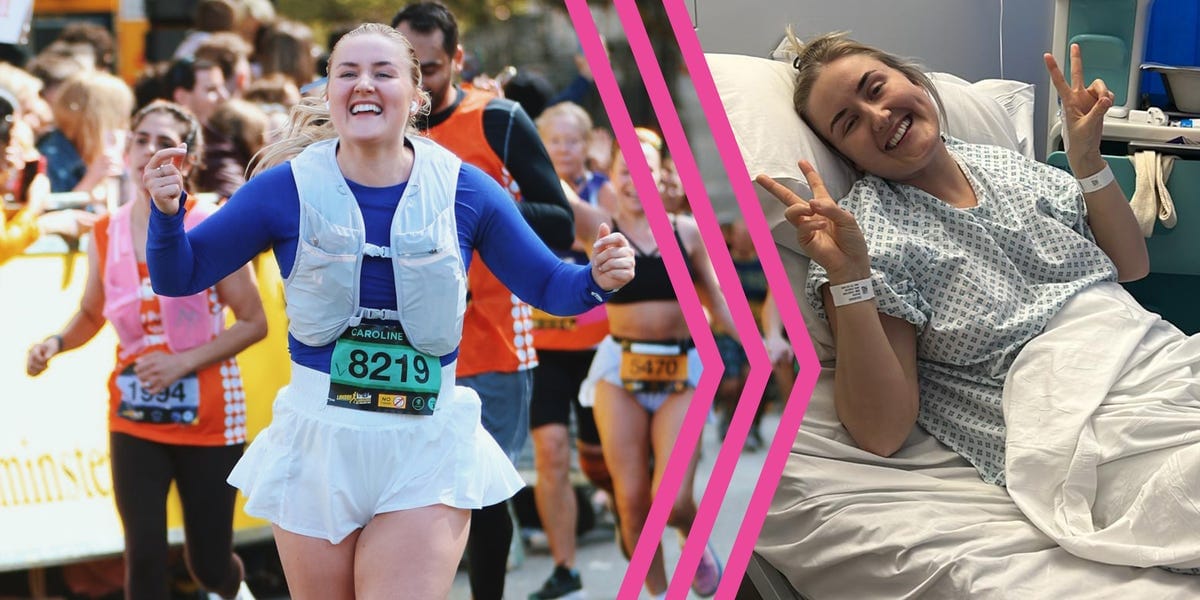
Reported by Women's Health Magazine.
At 28, a sharp pain radiating through her hip, knee, and groin stopped her mid-stride on an ordinary sidewalk. What followed wasn't a quick diagnosis and a clean recovery — it was two years of chronic pain, misdiagnoses (first bursitis, then a torn labrum), crutches, a wheelchair, and the kind of dependence on others that strips you of yourself. According to Women's Health Magazine, the real culprit was hip dysplasia — a congenital condition where the hip socket fails to adequately cover the joint — something she'd had her entire life without knowing.
The fix was a periacetabular osteotomy (PAO), one of the most technically demanding hip preservation surgeries available: bones cut, repositioned, and anchored back to the pelvis with screws. Then, a second PAO on the right hip two months after she completed her first half-marathon. Because of course. She did both. She recovered from both.
The Comeback Protocol
Rebuilding wasn't dramatic — it was methodical. Physical therapy multiple times a week, starting with leg lifts, glute bridges, and clamshells. A deliberate focus on the mind-muscle connection to retrain a post-surgical body that had essentially forgotten how to activate its own lower half. Five and a half months after her first surgery, she started run coaching — training by time rather than mileage, building from a few minutes at a stretch to 35-minute easy runs to two-and-a-half-hour long runs. Eleven months post-op: a finished half-marathon. A year after the second surgery: another half-marathon, seven minutes faster than the first.
Her current routine — running and strength training three times a week, reformer Pilates for mobility and core work — reflects something she learned the hard way: that sustainable fitness is built in the margins, not the milestones. The professionals in her corner mattered enormously. A run coach who adjusted training week by week, a physical therapist who prioritized protection alongside progress. Neither pushed harder than her body could handle, and that restraint was the point.
Two surgeries, years of misdiagnosis, and 26.2 combined race miles later, the lesson isn't inspirational-poster material — it's practical: recovery is not linear, perfection is not the goal, and the right support system is not optional. Showing up consistently on the hard days, scaling back when necessary, and trusting the slow build — that's what gets you to the finish line.
Your body can survive more than you think it can, but it needs the right team, the right timeline, and the grace to let both do their work.
Read the original at Women's Health Magazine.