Imagining What Comes Next for Black America
An exhibit of Betye Saar’s doll collection, the Schomburg Centennial, and the new book They Stole A City point to a changing America
Reported by Harper's Bazaar.
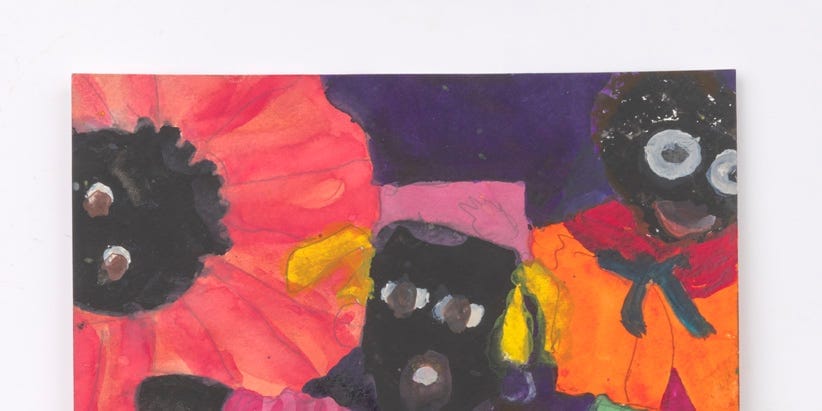
Betye Saar turns 100 in July, and the New York Historical Society is marking the occasion with Betye Saar's Black Dolls — an exhibition built from the artist's personal doll archive, now displayed alongside the watercolors she painted of them during the pandemic. It is a quiet, devastating show. One object in particular refuses to let go: a topsy-turvy doll with two faces, one Black, one white, installed with a mirror behind it so that the white face appears only as a reflection over the Black face's shoulder. The museum may not have intended the metaphor to land this hard, but it does. Black existence under surveillance, interrupted, doubled — always aware of who's watching.
That image has weight precisely because of what it references. According to Harper's Bazaar, Saar believes dolls absorb the spirit of the children who loved them — "they each have a history, and I feel some even have an energy of their past life," she said. The collection also calls back to the landmark doll test conducted by psychologists Kenneth and Mamie Clark in the 1940s, in which both Black and white children assigned positive qualities to white dolls and negative ones to Black dolls. The study became evidence in Brown v. Board of Education. The dolls weren't just toys. They were documents of what systemic exclusion does to an interior life.
What Endures
The same week as the Saar exhibition, the Schomburg Center for Research in Black Culture held its centennial gala at the New York Public Library — a room dense with a century's worth of Black intellectual life. Honorees included Edwidge Danticat, Henry Louis Gates Jr., Angela Bassett, Nikole Hannah-Jones, and Solange Knowles. The institution itself was founded in 1925 by Afro-Puerto Rican librarian Arturo Schomburg, who began archiving Black books and artifacts at a moment when the dominant culture flatly denied that African diasporic people had history worth preserving at all. That the Schomburg has survived — through backlash after backlash — is not a small thing.
It's impossible to sit inside that history right now without thinking about Lauren Collins's new book They Stole a City, which reconstructs the 1898 Wilmington coup — a meticulously organized white mob attack that dismantled a democratically elected, racially integrated government, burned the Black quarter of town, and exiled its Black leadership. President McKinley declined to intervene. It would take 70 more years and the Voting Rights Act before anything resembling that lost political power returned — and now, with the Supreme Court having significantly weakened that same act, the cycle feels sickeningly familiar. Collins, who grew up white in Wilmington and learned about the coup only as an adult, frames herself as "an implicated subject" — a position she argues applies to every American, regardless of proximity. There is, she writes, no such thing as the mercy of late birth.
What connects Saar's dolls, Schomburg's archive, and Collins's reckoning is the same insistence: that Black history is not a wound to be managed but a record to be held, and that forgetting it — or being made to forget it — is itself an act of violence. The work of preservation has never been decorative; right now, it is essential.
Read the original at Harper's Bazaar.