In Los Angeles, Hermès Takes Flight
The brand’s Resort 2027 show celebrated the body in motion
Reported by Harper's Bazaar.
Hermès doesn't do anything casually, and its latest resort show — staged on a hilltop in Bel-Air as the sun melted into the Pacific — made that very clear. Artistic Director of Women's Ready-to-Wear Nadège Vanhée chose a pale yellow pavilion erected beside the Hotel Bel-Air (a venue that, per insider whispers, once hosted a private Beyoncé and Jay-Z event) as the setting for "Silhouettes on the Horizon." The audience included Keke Palmer, Julia Louis-Dreyfus, Kerry Washington, and Miley Cyrus, alongside a front row of clients whose Birkins and Kellys represented a staggering concentration of the world's rarest leathergoods. According to Harper's Bazaar, the walls of the space literally glowed as light bounced off the yellow interior at dusk.
The Body in Motion
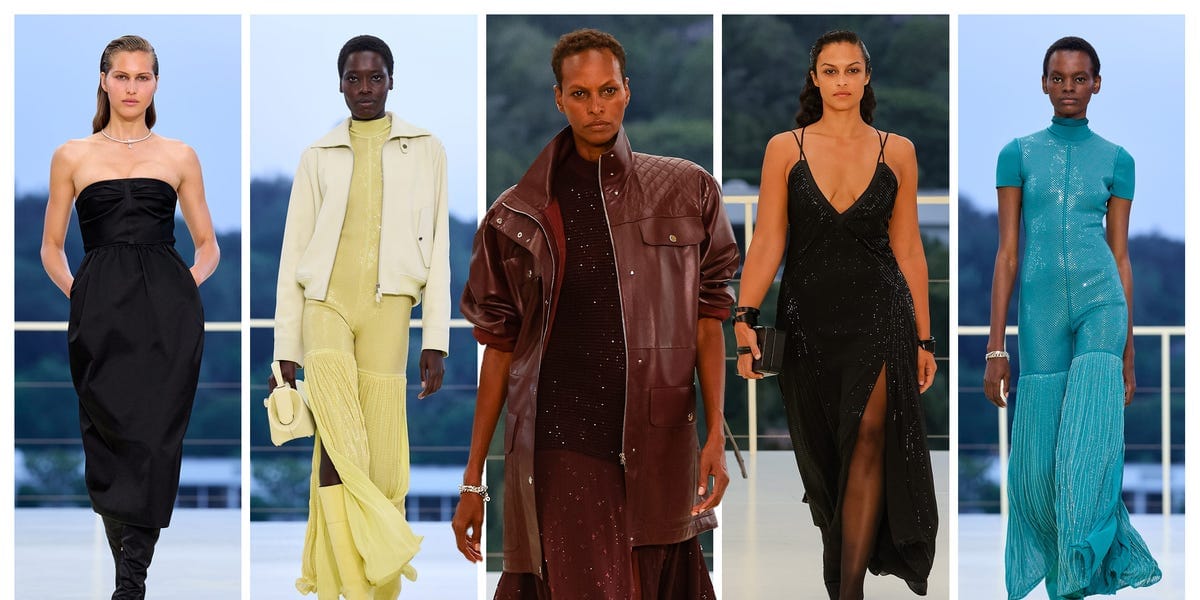
The collection's guiding idea — where "dressmaking meets dance" — announced itself immediately. Model Awar Odhiang opened in a pale yellow fringed jumpsuit that moved with her like a second skin, every step sending the hem into fluid motion. Model Yasmine Warsame followed in a maroon leather jacket and coordinating embellished dress that flared at the hem, pulling audible reactions from Washington and Cyrus in the crowd. This was clothing designed to be worn by a body that actually moves — not posed in, not preserved behind glass.
The collection's midpoint leaned hard into Vanhée's leather signatures: cropped wrap jackets, corset dresses with tulip hems, and the sleek cigarette pants she's made something of a house calling card. Color arrived as punctuation — saturated yellow, red, and teal satin dresses with body-following piping and functional pockets, their construction nodding to the smooth utility of a ballet slipper. It was athleticism rendered in couture logic.
Then, as the sky darkened over Los Angeles, the energy shifted. The closing looks were a series of slinky black gowns in satin and velvet — slower, more considered, quieter in their confidence. If the first half of the show was about momentum, this half was about what happens when you finally stop. The transition felt intentional and earned, not just a mood change for drama's sake.
What Vanhée built here was essentially a wardrobe philosophy mapped onto a single show: clothes for the full arc of a day, from the kinetic to the still, without sacrificing either edge or elegance along the way.
Read the original at Harper's Bazaar.