Larger Than Life, the Work of Helen Frankenthaler Takes Over Gagosian
“Helen Frankenthaler: The Moment and the Distance” is on view at Gagosian, 522 West 21st Street in New York City, through July 2.
Reported by Vogue.
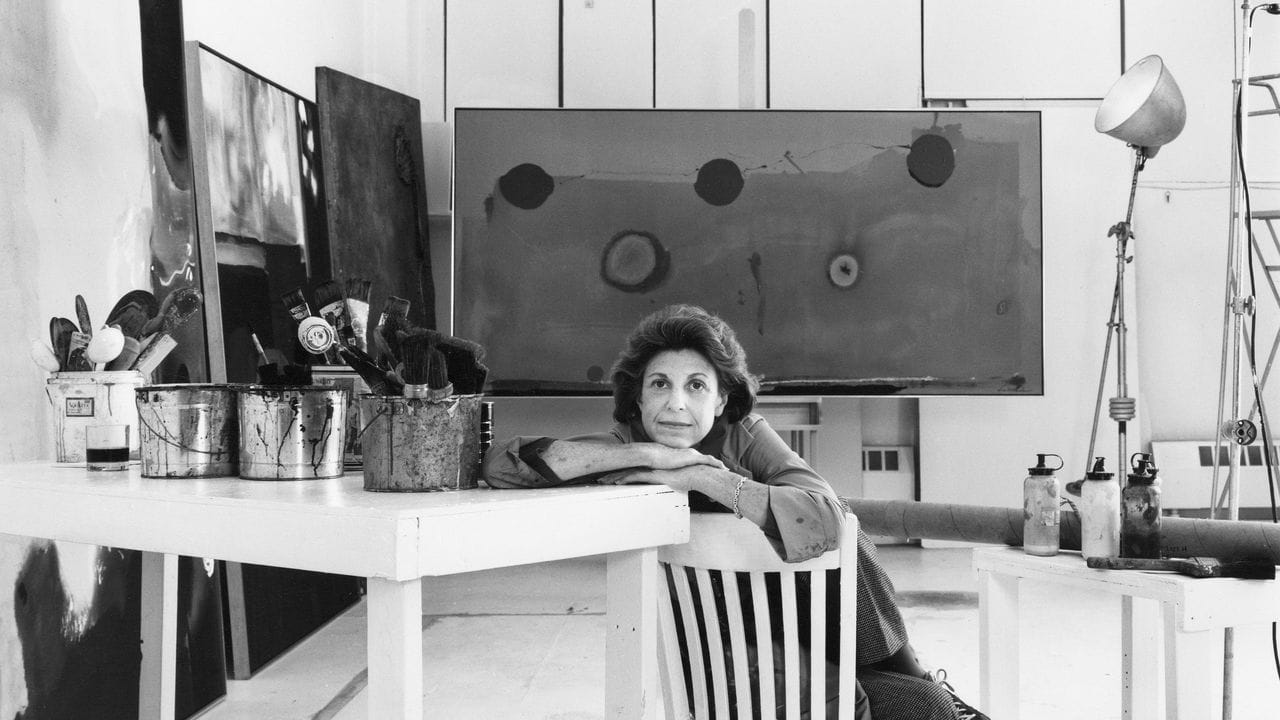
There is a particular kind of confidence that doesn't perform itself — it simply takes up space. Helen Frankenthaler had it in abundance, and right now, twenty-two of her largest canvases are demanding you reckon with it. Helen Frankenthaler: The Moment and the Distance, currently at Gagosian's West 21st Street location through July 2, gathers paintings spanning 1960 to 1992, each measuring at least 100 inches in at least one direction. The scale is the first statement. The evolution is the argument.
According to Vogue, the show is hung chronologically — a first for Gagosian director Jason Ysenburg, who has organized ten Frankenthaler exhibitions over the years. It's the right call. Starting with Alassio (1960) and Provincetown I (1961), both made with oil on raw, unprimed canvas, you can trace the direct lineage back to her 1952 breakthrough, Mountains and Sea — the painting that introduced her signature soak-stain technique and quietly rewired abstract painting for an entire generation, laying the groundwork for the color field movement. What reads as effortless was, in fact, radical.
Kept Close, Now Revealed
Several works in the show have rarely, if ever, been seen publicly. Frankenthaler was known to hold onto her favorites — not because they didn't sell, but because she simply refused to let them go. The 11-foot Gamut (1968), a torrent of purple cutting against tangerine, is one such painting; Ysenburg believes it hasn't been on view since Henry Geldzahler included it in a 1969 group show at the Metropolitan Museum of Art. Nearby, Moontide (1968) — blue, peach, ochre, sumptuous — is one of three Frankenthaler works that inspired Ulla Johnson's spring 2026 collection. Frankenthaler herself reportedly bristled at being called lyrical, feeling the word undersold the depth of what she was doing. She wasn't wrong.
Her post-divorce work from the 1970s hits differently once you know the context — colors more saturated, lines reintroduced with marker, the mood shifting between clarity and restlessness. By then she was already a critical darling: her 1969 Whitney retrospective earned a New York Times review calling her "one of our best painters," and her first solo museum show had come in 1960, when she was just 31. She'd secured her first solo gallery show at 22, fresh out of Bennington. Elizabeth Smith, executive director of the Helen Frankenthaler Foundation, puts it plainly: "Her work can look different even in the same year, and certainly across the decades." She didn't repeat herself. She interrogated herself.
If you want more, Kunstmuseum Basel has an exhibition of 50-plus works focused on her art historical references, and Manhattan's Yares Art is showing Similitudes: Color, Form, Friendship, tracing her relationship with sculptor Anthony Caro through works that mirror each other in color and shape. The Frankenthaler moment is clearly now — and the lesson she leaves behind is that reinvention, done with both rigor and instinct, is the longest game there is.
Read the original at Vogue.