L’Oréal Paris’s Path to €10 Billion
In her first interview since taking on the role, L’Oréal Paris global brand president Laetitia Toupet discusses the brand’s mission, white space, and the Cannes Film Festival.
Reported by Vogue.
L'Oréal Paris already sits at over €7 billion in annual revenue. The target is €10 billion. And the woman tasked with closing that gap is Laetitia Toupet, who stepped into the global brand president role in July 2025 with a reputation built on exactly this kind of ascent — she previously helmed La Roche-Posay and shepherded it past the €1 billion milestone. L'Oréal Paris is a considerably bigger machine, but the ambition is the same: deliberate, strategic, and unapologetic about scale.
According to Vogue, the brand posted mid-single-digit growth in 2025 — a deceleration from the 9% it logged in 2024, with haircare and makeup doing the heavy lifting. The competitive pressure is real: indie brands are eating into the US youth market, Chinese labels are positioning themselves as credible alternatives, and K-beauty is nowhere near its peak. Toupet isn't pretending the road is clear. She's mapping it anyway.
Science, Skin, and the GLP-1 Moment
Skincare is the acknowledged weak point, and Toupet's dermatological background is the not-so-subtle signal of where the brand intends to grow. The newly launched Glass Skin range — inspired by Asian formulations, built on L'Oréal Group's Seoul R&D center — helped the brand return to growth in China after a rough prior year. "Being very strong in Asia gives us a competitive edge by allowing us to innovate much faster," Toupet says. Equity analyst Pierre Tegnér of Oddo BHF frames the challenge clearly: mass brands like L'Oréal Paris need to carve out territory between derm and luxury while keeping pace with K-beauty's momentum. The strategy, per Toupet: use science to deliver results that are visible, not just promised. The brand is also moving into GLP-1 territory — directly addressing the hair thinning and skin sagging associated with weight-loss treatments through its Elseve and Revitalift ranges. It's a smart, unsentimental read on where women actually are right now.
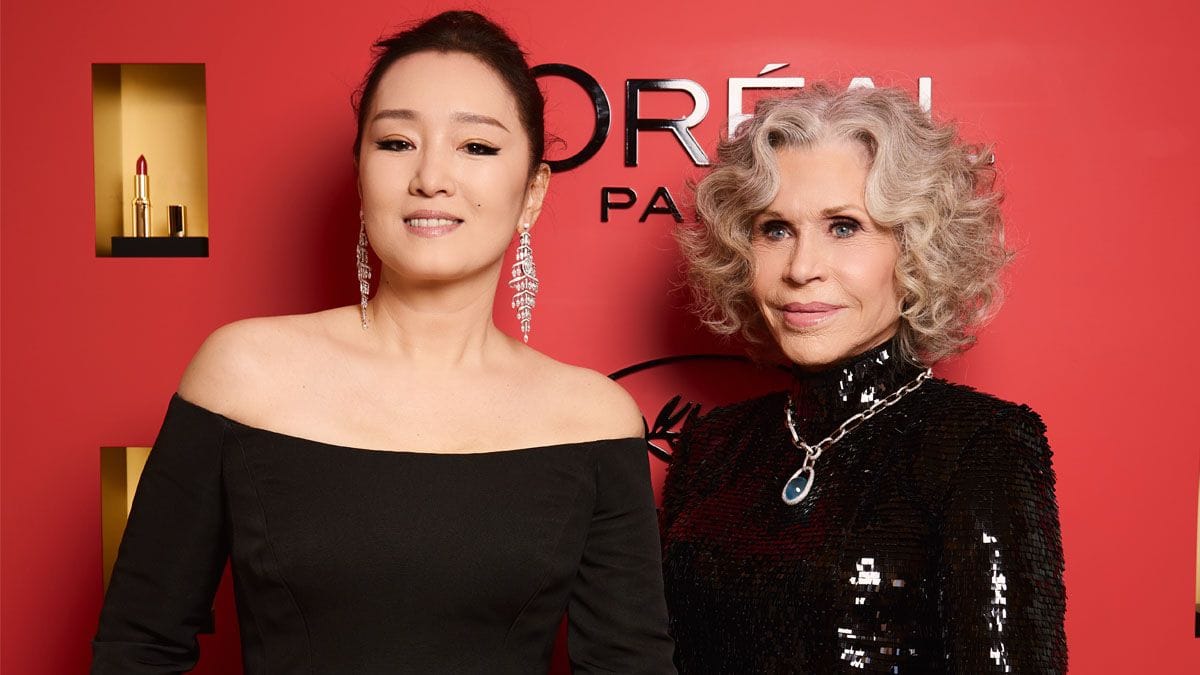
On the cultural side, the Cannes Film Festival remains the brand's biggest stage — 29 years as an official partner, and this year the facade of the Hôtel Martinez was covered wall-to-wall with ambassadors: Jane Fonda, Eva Longoria, Gong Li, Viola Davis. The 2025 festival generated a potential reach of 20 billion social and press impressions and an ad value of €325 million. It's not just prestige dressing — every red carpet look links directly to a "get the look" product breakdown, funneling festival heat straight to e-commerce. Fonda, 88 and celebrating her 20th year with the brand, opened the festival alongside Gong Li, who hit 30 years. "Why do they want me? I'm not a model," Fonda says. That's exactly the point.
The men's category is next. Formula 1 drivers Charles Leclerc and Carlos Sainz are now brand ambassadors, anchoring a push into Men Expert skincare that Toupet describes as a full recruitment strategy — meeting a market that's already moving toward self-care and accelerating it. The €10 billion number stops sounding like a stretch when you see the full picture: skincare science, cultural dominance, category expansion, and a brand that's been telling women they're worth it long enough to finally mean something by it.
L'Oréal Paris isn't chasing relevance — it's engineering it, one category gap at a time.
Read the original at Vogue.