LVMH Announces the Winners of Its 2026 Innovation Awards
London-based AI video-generation startup Synthesia was awarded the ‘Best Business’ prize by LVMH during Vivatech in Paris, while Bluefish AI, which measures brand image across AI engines, won ‘Most Promising’.
Reported by Vogue.
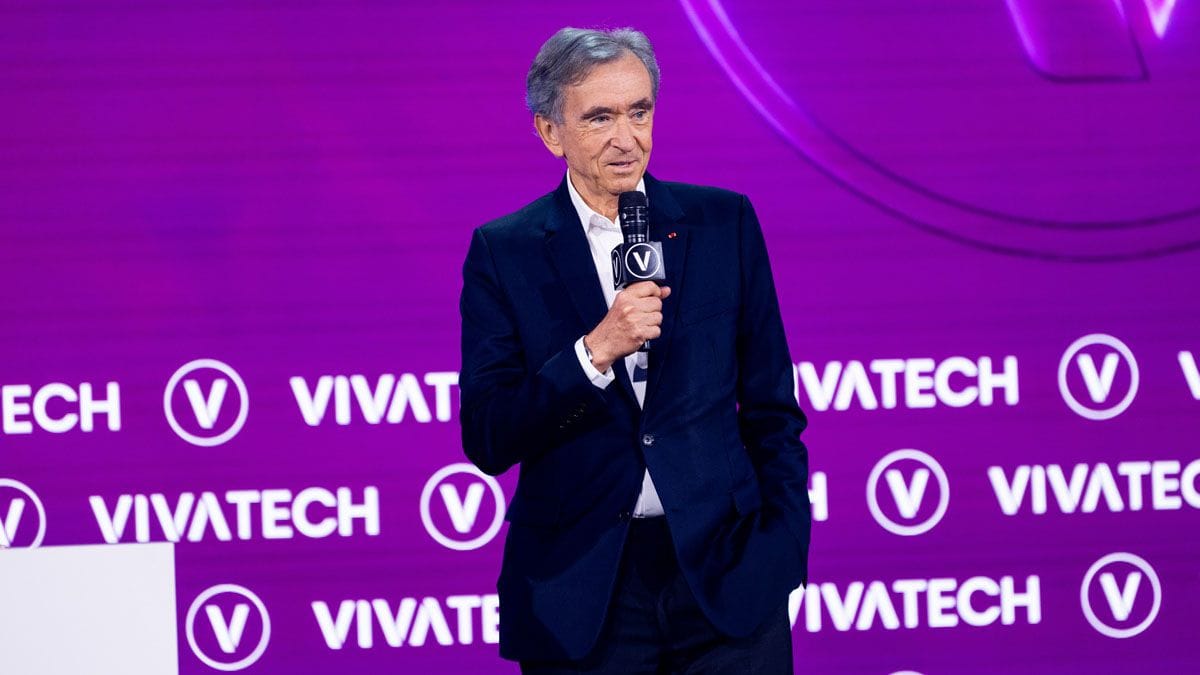
Bernard Arnault calls LVMH a startup. Not metaphorically — the man said it at Vivatech in Paris this week, at the tech conference he co-founded, which is celebrating its 10th anniversary. "I run a startup. I consider my group as a startup. We are a conglomerate of startups," he told the opening ceremony crowd. Whether you find that charming or delusional probably depends on your feelings about billionaires, but the point he's making is real: the conglomerate is betting heavily on technology, and the annual LVMH Innovation Award exists to prove it.
This year's three winners, announced at Vivatech, span sustainability infrastructure, AI training, and the increasingly critical question of how luxury brands show up in a world where consumers Google less and prompt more. According to Vogue, French startup Fairly Made took the Best Impact Prize for its raw material traceability and supply chain transparency platform — already in use across LVMH's fashion and leather goods houses. In an industry where "sustainable" has become the world's most abused adjective, a tool that actually maps environmental impact through the supply chain is genuinely useful.
From SEO to GEO: The Shift LVMH Is Paying Attention To
The Best Business Award went to Synthesia, the UK-based AI video-creation company that recently closed a Series E round at a ~$4 billion valuation, led by Google Ventures with Nvidia's VC arm participating. LVMH Group IT and technology director Franck Le Moal put it plainly: training tens of thousands of employees across global storefronts and industrial sites is a logistical beast, and Synthesia's ability to generate, personalize, and real-time translate training content is the appeal. A dozen houses — including Parfums Christian Dior, Tiffany & Co., Loewe, Moët Hennessy, and Hublot — are already using it.
The Most Promising Award went to New York-based Bluefish AI, co-founded by Alex Sherman, Andrei Dunca, and Jing Feng. The platform tracks how brands appear across AI engines — ChatGPT, Gemini, Perplexity, Mistral — which Le Moal framed as the industry's next defining challenge. "We are moving from SEO to GEO," he said, referencing generative engine optimization. E-commerce transactions through AI tools are still minimal, but vast numbers of potential customers are using these platforms to research products and brands. Louis Vuitton, Christian Dior Couture, and Loro Piana are among the houses already using Bluefish to understand — and improve — that presence. In 2016, Le Moal noted, only Louis Vuitton and Sephora had made serious technology investments; now every LVMH house has. As a footnote, Arnault mentioned he joins a weekly AI design session. "It's fun," he said.
Luxury's next competitive edge isn't just in the product — it's in whether your brand even exists in the answer an AI gives someone who's never typed a search query in their life.
Read the original at Vogue.