Lynette Yiadom-Boakye Returns to New York With a Defined Intent
The artist’s new work at Jack Shainman Gallery has a defined intent.
Reported by Harper's Bazaar.
There's a particular kind of freedom in refusing to explain yourself. Lynette Yiadom-Boakye has built an entire practice around it. The Ghanaian British painter is back in New York with "Many a Moonlight Caveat," a 46-work exhibition split across Jack Shainman Gallery's Chelsea and Tribeca locations — her first major U.S. solo show in six years — and the statement it makes isn't loud. It doesn't need to be.
The show spans oil-on-canvas paintings and charcoal-on-paper works, arranged across both venues as a single unified project rather than segregated by medium. According to Harper's Bazaar, the two-space concept crystallized after Yiadom-Boakye visited Shainman's Tribeca outpost in person. "Once Tribeca opened, that was when she started thinking about what the show might look like," said gallery executive director Tamsen Greene, who has worked with the artist for over a decade. The paintings — layered in teal, ultramarine, cerulean, and ebony — pull you into dining rooms, dance studios, bedrooms, and funeral processions populated by fictional figures built from memory, invention, and photographic reference. The charcoal works go quieter: solitude, grief, movement suspended mid-breath.
The Politics of Not Explaining
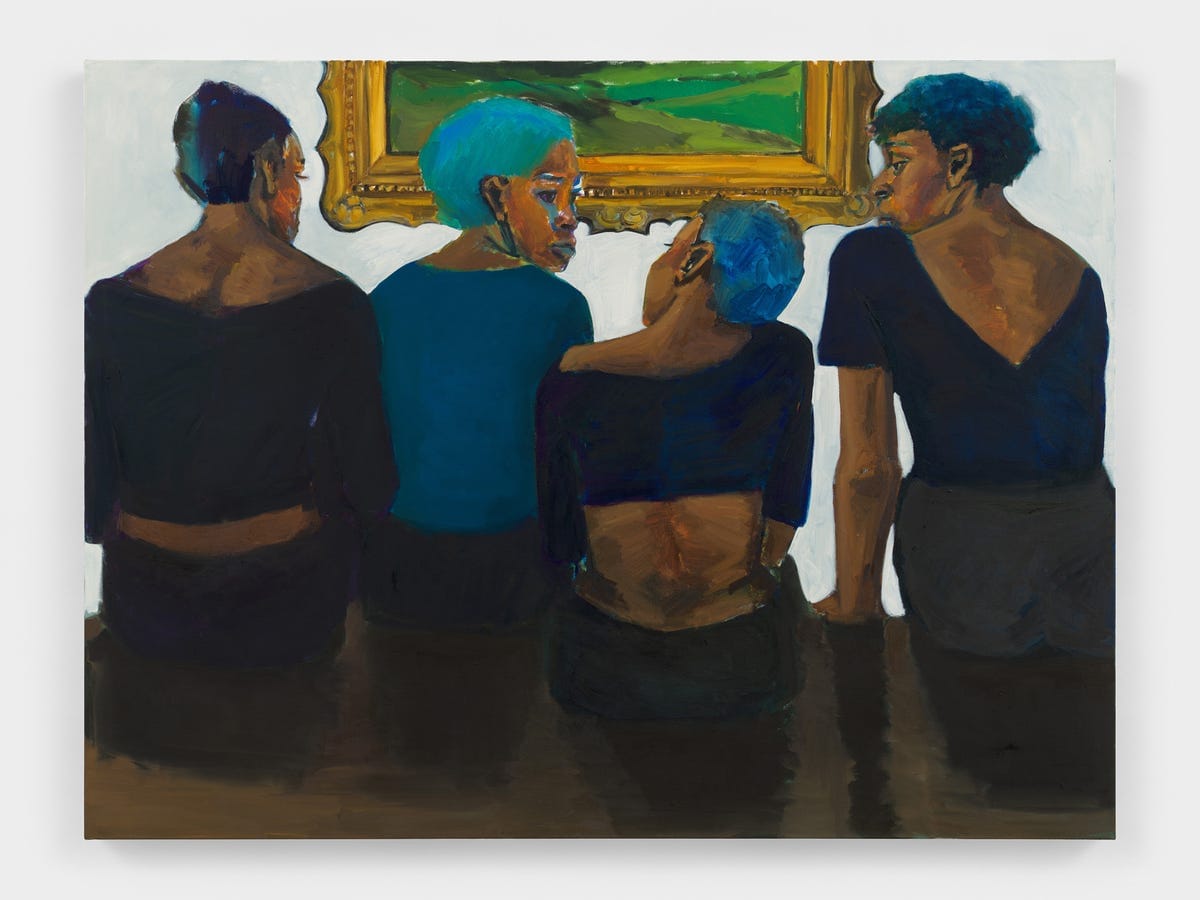
Yiadom-Boakye's figures are not waiting for your interpretation. Most don't look back at you. In A Cause for Pastoral Concern, four women sit before a landscape painting, gazes drifting anywhere but toward the canvas — a composition that creates tension without instruction. The collar motif that recurs across her work, most visible in the Bird of Reason sketches, has been read as a nod to 17th-century Dutch portraiture, as ancient African warrior regalia, as pure formal invention. When Greene put the question directly to Yiadom-Boakye, the artist called them simply feathered collars. "If she tells you her story about something, it almost closes it instead of opens it," Greene noted. That's not evasion — that's architecture.
The artist's visibility in recent years has been deliberate and well-placed: Stone Arabesque, a quadriptych of Black dancers in white leotards, appeared in the Brooklyn Museum's 2024 "Giants" exhibition drawn from Swizz Beatz and Alicia Keys's collection. Two large paintings — Fly Trap and A Knave Made Manifest, both created specifically for the occasion — anchored the Whitney's "Edges of Ailey." Solo shows at the Tate and Guggenheim Bilbao sit in the background like quiet credentials. "Many a Moonlight Caveat" builds on all of it, and then refuses to summarize it. "I've never distinguished my politics from my life," Yiadom-Boakye said in a 2022 Tate interview. "I make the work that I want to make, regardless of who has made it their life's work to hate me."
The show runs through July 31 — and the only thing it demands of you is to stop waiting for someone to tell you what to feel.
Read the original at Harper's Bazaar.