Nobody Collected Couture Like Azzedine Alaïa
A new book catalogs the new exhibition, “Azzedine Alaïa and Christian Dior, Masters of Couture”
Reported by Harper's Bazaar.
The word "archive" gets thrown around constantly now — on red carpets, in auction houses, in every other fashion essay on the internet. But before archiving became a cultural currency, before brands understood that their history was also their future, one designer was quietly doing what no one else thought to do. Azzedine Alaïa kept everything. His own work, yes — but also the work of Cristóbal Balenciaga, Christian Dior, Thierry Mugler, Madame Grès — collected not as an investor or an institution, but as a student who never stopped being in awe. According to Harper's Bazaar, Dior himself didn't start collecting his own work until 1987. Alaïa was collecting Dior in the late 1970s.
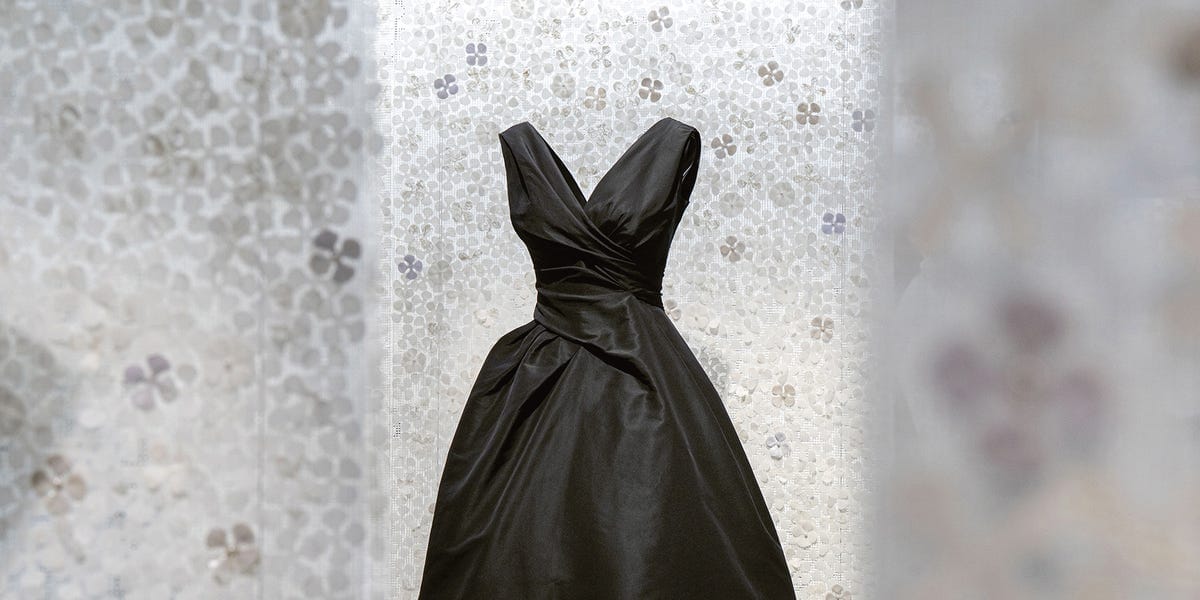
That obsessive, generous vision now lives inside La Fondation Azzedine Alaïa, co-founded by Alaïa, Carla Sozzani, and Christoph von Weyhe in 2007. Since 2020, the foundation has staged four exhibitions placing Alaïa in direct conversation with the couturiers he revered. The latest — Azzedine Alaïa and Christian Dior, Masters of Couture — closes this June, and its accompanying catalog has just been published by Damiani Books. Foundation president Sozzani and director Olivier Saillard spoke to the connections that make this particular pairing so charged: Alaïa worked at Dior for exactly four days after arriving in Paris, and spent the rest of his career in quiet dialogue with everything those four days represented.
Two Revolutions, One Silhouette
The throughline between both designers is the waist — defined, celebrated, structural. But their methods couldn't be more different. Dior rebuilt femininity post-war with long skirts and internal corsetry. Alaïa dismantled the corset entirely, engineering stretch fabrics cut so precisely the clothes did the body's work themselves. As Saillard puts it, "He shaped the '80s like Dior shaped the '50s" — a quote originally from critic Suzy Menkes that has only sharpened with time. A donated 1958 dress, one of Alaïa's oldest known pieces and now part of the exhibition, shows how early and how seriously he was absorbing Dior's vocabulary before making it entirely his own.
What sets Alaïa apart from virtually every peer isn't just what he made — it's what he saved. Sozzani notes that Jean-Paul Gaultier kept nothing. Vivienne Westwood kept nothing. Alaïa kept everything, in multiple sizes and colorways, from day one, when no one was watching and no one thought to. Saillard calls him "the very first, most important private collector devoted to the history of fashion" — a designation that feels more urgent as the industry increasingly looks to images over objects, and social media flattens the distinctions between brands into a single aesthetic blur. The foundation's exhibitions are a deliberate counter-argument: clothes, seen up close, without glass between viewer and garment, do something a photograph simply cannot.
At a moment when craft is making its way back into the conversation — slowly, imperfectly, but genuinely — Alaïa's archive isn't just a monument to two great designers; it's a working argument for why fashion's future depends on understanding what its hands once knew how to do.
Read the original at Harper's Bazaar.