On <em>Lemonade’</em>s 10th Anniversary, Pipilotti Rist Talks “Hold Up” Music Video
“I consider it an homage by a great artist, and it made me proud,” the Swiss artist tells Bazaar
Reported by Harper's Bazaar.
Ten years after Lemonade cracked culture open, the image still lands: Beyoncé in a billowing yellow gown, baseball bat in hand, caving in car windows like it's the most natural thing in the world. The "Hold Up" music video — directed by Jonas Åkerlund — made rage look like joy, destruction look like freedom. What fewer people discussed at the time was where that visual language came from.
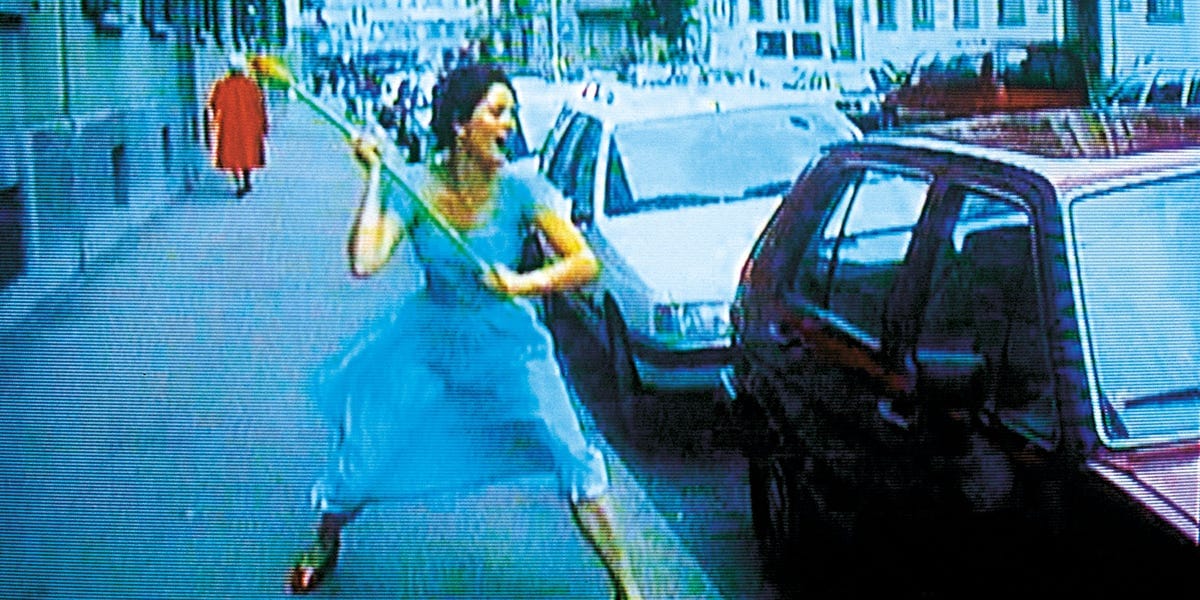
Swiss artist Pipilotti Rist debuted Ever Is Over All at the 1997 Venice Biennale, where it won the Premio 2000 award. The audiovisual installation — two projections running simultaneously — shows a woman in a blue dress and ruby heels strolling down a street, swinging an oversized metal flower. She smashes car windows. She smiles. A woman hums softly in the background. The parallels to "Hold Up" are not subtle, and according to Harper's Bazaar, Rist is speaking about the connection for the first time. "I consider it an homage by a great artist, and it made me proud," she says. "The influence between music, film, and fine art has always flowed in all directions."
The Flower vs. The Bat
Both works hinge on the same subversive twist: a woman who appears unthreatening suddenly destroys property — and the destruction reads as relief, not menace. Rist is precise about intent. "I intend for the viewer to experience this destruction as joyful rather than terrifying," she explains. "Its enduring appeal lies in the metaphor of a flower being stronger than a car, suggesting that nature's strength and underlying physics are more complex and powerful than human-built products." The ruby heels, she adds, place the protagonist in a fantastical realm — Dorothy-coded — where the rules of society simply don't apply. Where women have magical agency to reshape the world around them.
The thematic gap between the two works is where it gets interesting. Rist's flower channels environmental frustration; Beyoncé's bat channels something far more personal and specific. "The contrast lies in the tool," Rist says. "She uses a baseball bat instead of a flower, which carries a different and additional message." We all know whose name was on that bat. And yet, Rist insists, the throughline holds: "Both works effectively transform destructive energy into hope." The woman in the blue dress smiles wider after every smashed window. Beyoncé switches from fury to dancing mid-street. The math is the same.
With Ever Is Over All heading to the Guggenheim Bilbao on October 10 and Lemonade turning ten, the conversation about who owns an image — and how women's rage travels across mediums — feels newly urgent: the most radical thing a woman can do on screen is still destroy something and look absolutely delighted doing it.
Read the original at Harper's Bazaar.


