Remembering the Vogue Photographer, Duane Michals, Who Has Died at 94
Duane Michals’ work for Vogue included fashion portfolios, reportage, and portraits of notables from Robert Redford to Philip Glass.
Reported by Vogue.
Duane Michals, one of the most unconventional photographers to ever work in fashion, died on June 9 at the age of 94. His path to the lens was anything but linear — born in McKeesport, Pennsylvania in 1932, he studied graphic design at Parsons after earning his degree from the University of Denver, fully intending to become an art director. Then came a 1958 trip to the U.S.S.R., a camera in his hands, and a complete change of plans. The photographs he took on that trip became his first exhibition at New York's Underground Gallery in 1963.
Michals built his fine art practice through the late 1960s while quietly beginning to shoot for Condé Nast. One early assignment — a portrait of Johnny Cash for Mademoiselle's November 1969 issue — already signaled what made him different. Rather than simply render his subject, Michals shot Cash through a window, weaving his own reflection into the frame. That instinct to insert himself into his images, to layer text into photographs and construct meaning across sequences of pictures, would define his legacy. According to Vogue, critic Philip Gefter described him in The New York Times as "an artist of significant consequence" and credited him as "the father of the photographic narrative sequence." He was also openly gay at a time when most of his peers were not.
The Fashion Pages as a Canvas
Throughout the 1970s and '80s, Michals shot regularly for Vogue — Robert Redford and Mia Farrow on the set of The Great Gatsby, the San Francisco Ballet, jewelry designer Elsa Peretti in her studio, portraits of Yves Saint Laurent, Philip Glass, Dudley Moore. But his most celebrated fashion work came in 1976, when he shot both the spring and fall collections. For spring, he brought models into the Vogue art department at 350 Madison and photographed them as working women — moving through the actual room where the magazine was assembled. Former model Chris Royer recalls that working with Michals was like a "treasure hunt," a phrase she borrows from the Hungarian kinscvadászat: you knew you were going somewhere, you just didn't know what you'd find.
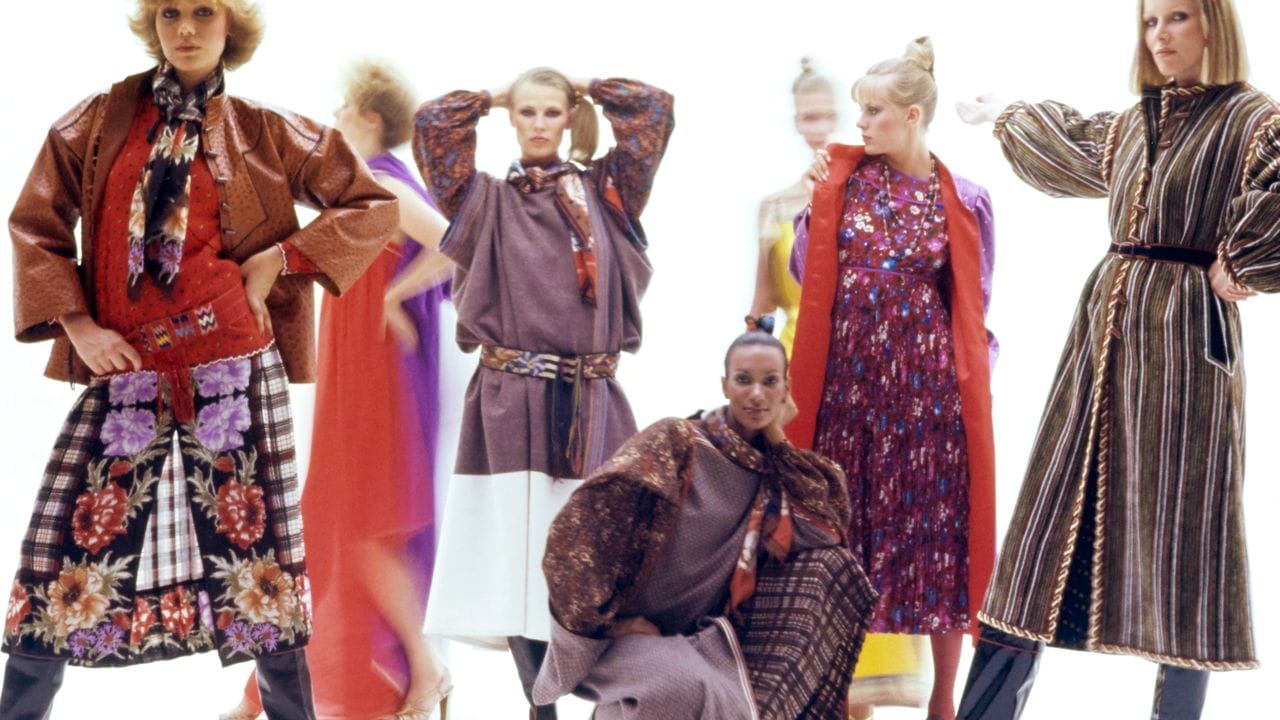
For fall, he did something structurally opposite. Michals moved into the Carnegie Hall studio of photographer Edita Sherman — the so-called "Duchess of Carnegie Hall," who lived and worked there for over six decades — and shot a large ensemble of models using a slow shutter speed, letting motion blur into something closer to feeling than documentation. Hair stylist Christiaan, who worked the shoot, remembered Michals as "somewhat demure with a friendly determination," moving through the room like he was conducting something invisible. The resulting images vibrate with an energy rarely captured in a studio setting. Everyone on set was nervous, Christiaan admits — Michals wasn't a typical fashion photographer. But everyone knew they were part of something that mattered.
Duane Michals didn't make fashion photography feel like fashion photography — he made it feel like art with a pulse, and that distinction is exactly why his work still holds.
Read the original at Vogue.