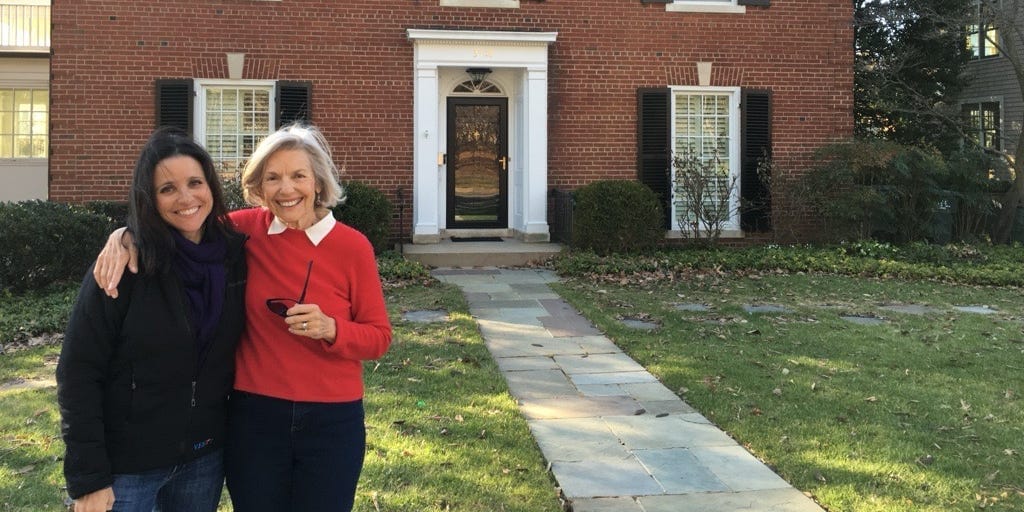
<strong>Happy Mother’s Day! Here’s Julia Louis-Dreyfus and Her Mom, Judy Bowles, in Conversation</strong>
The comedy legend and her mom on raising adult children and why aging is just constant pivoting
Reported by Harper's Bazaar.
There is a moment at the end of every episode of Wiser Than Me — Julia Louis-Dreyfus's podcast — that has nothing to do with celebrity and everything to do with something more lasting. The mic goes down, the guest is gone, and Louis-Dreyfus picks up the phone to call her mother. Not for content. Just to talk. To share what she heard, what moved her, what stayed. It's a small ritual that turned into the show's most compelling feature, and according to Harper's Bazaar, it's the reason the podcast works at all.
Launched in spring 2023 with a deceptively simple premise — Louis-Dreyfus in conversation with women older and wiser than herself — Wiser Than Me has hosted Fran Lebowitz, Vera Wang, Julie Andrews, Anne Lamott, Joan Baez, and Diana Nyad, among others. But the closing calls with her mother, poet and triple-threat matriarch Judy Bowles, now 92, are what listeners actually remember. Not because they're sentimental. Because they're real. Two women — one 65, one 92 — still genuinely curious about each other, trading insight with the easy shorthand of people who have been paying attention to one another for decades.
What Older Women Know
When asked their ages and how old they feel, both women gave the same slippery, revealing answer: younger. Bowles, who says she sometimes feels 40, sometimes 20, attributes it to what she calls "a steady center" — an inner thread that doesn't age even as the body does. Louis-Dreyfus, at 65, says she feels 35. "I'm stealing my mother's answer because I'm no dummy," she said. The best wisdom from the podcast has the same quality — specific, earned, quietly radical. Joan Baez told Louis-Dreyfus that forgiveness works "on a dimmer," meaning it's ongoing, never simply finished. Jane Fonda and Anne Lamott both offered the same three words: no is a complete sentence. Bowles's favorite story came through Nyad, about Julia Child — who, on the day her husband first failed to recognize her due to illness, invited a journalist and her colleagues inside anyway and made them all an omelet. "She knew that about herself," Bowles said. "She knew service would do her good."
What makes the show work isn't access — it's attention. Louis-Dreyfus does serious research before each conversation, writes personal essays for the openings, and treats the whole thing less like a promotional vehicle and more like an investigation. "I fell backward into this," she told Bazaar, describing a vulnerability she hadn't fully planned for. Bowles, for her part, says she almost didn't understand why Julia wanted her on at all — until she realized she wasn't being asked to perform. She was just being asked to be her mother. "It was a chance to talk to Julia," she said. "Are you kidding? I would never pass that up."
Across breast cancer, the loss of her Palisades home, and decades in one of the most unforgiving industries on earth, Louis-Dreyfus keeps returning to the same source material: older women, and her mother specifically. Season three arrives as a reminder that the most radical thing a platform can do right now is hand the microphone to women the culture has largely decided it's done with — and let them finish the sentence.
Wiser than its title, the show makes the case that the best conversations aren't interviews at all — they're the ones you've been having your whole life.
Read the original at Harper's Bazaar.