Taylor Swift’s Style Evolution Through the Years
This showgirl has seen some seriously fashionable moments
Reported by Harper's Bazaar.
There are artists who change their sound, and then there are artists who change their entire visual language with every album cycle. Taylor Swift has spent nearly two decades doing the latter — and the throughline isn't just good styling, it's deliberate, almost architectural self-construction.
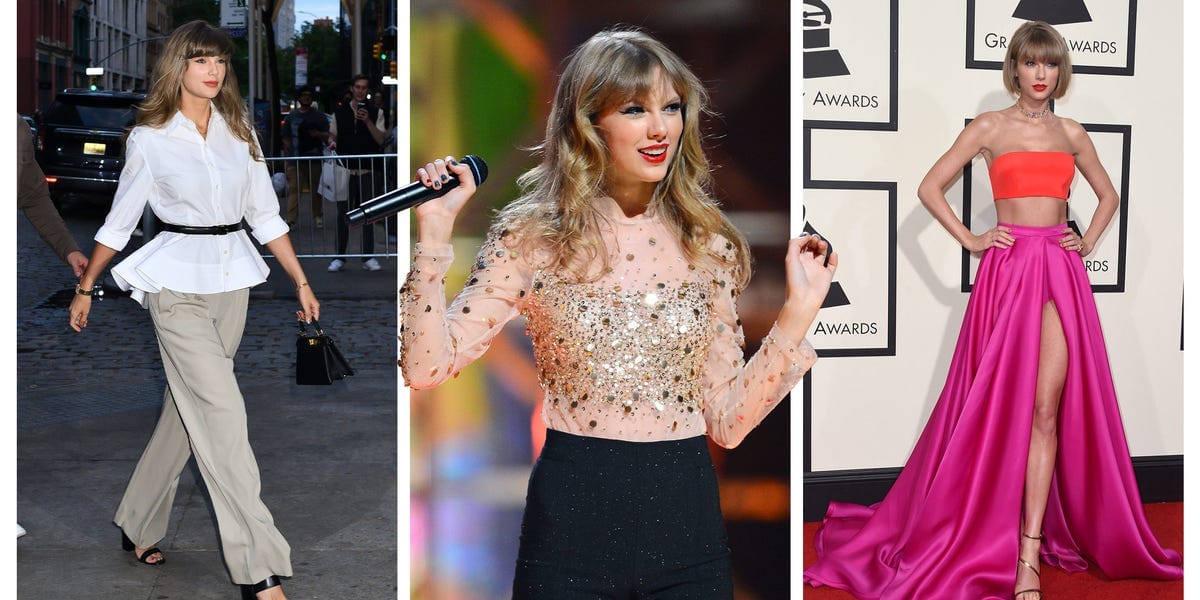
According to Harper's Bazaar, Swift's earliest red carpet appearances told a clear story: a 16-year-old in BCBG and cowboy boots at the 2006 ACM Awards, custom-matched boots at live performances, headbands and little white dresses through the Fearless and Speak Now eras. Her street style was equally consistent — skinny jeans, oxford shoes, chunky belts, a "13" scrawled on her hand like a talisman. It read as earnest country ingénue, and it was. But even then, the details were too precise to be accidental.
The Pivot That Changed Everything
The Red era introduced a new frequency. Swift started showing up in lace Elie Saab at the 2012 Billboard Music Awards, in a J. Mendel one-shoulder gown at the Met Gala, in bold red lips that matched the album's emotional temperature. She was still playing with femininity, but the references had shifted — sharper, more fashion-forward, less Nashville. By the 2013 CMA Awards, she was back in a floor-length Elie Saab red gown, the house having become practically a signature. Then came the 2014 Met Gala: a baby-pink Oscar de la Renta satin gown with Lorraine Schwartz jewelry and Christian Louboutin heels, paired with a fresh bob that functioned less as a haircut and more as a press release. Something is ending. Something else is starting.
Months later, she stepped out in New York in a crop-top two-piece — one of her first — and the 1989 era officially began. The cowboy boots were gone. The headbands were gone. What replaced them was a sleek, maximalist pop-star uniform that signaled not just a genre shift but a complete identity overhaul. The VMAs had already offered a preview: at the 2009 ceremony, she'd won Best Female Video for "You Belong with Me" in a shimmering Kaufman Franco gown and been famously interrupted by Kanye West — a moment that, in retrospect, sits at the fault line between her first chapter and everything that followed.
What Swift understood early — and has only refined — is that clothes are narrative infrastructure: every hem length, every house, every accessory is doing storytelling work that the music alone can't carry.
Read the original at Harper's Bazaar.