The Mannequins at This Year’s Met Exhibit Are Just as Important as the Clothes
It should inspire retailers and other fashion museums–as well as designers–to showcase clothes on real bodies
Reported by Harper's Bazaar.
The Met Gala's red carpet spectacle tends to swallow everything whole — the discourse, the drama, the takes. But the exhibit it nominally celebrates, Costume Art, running from May 10th through January 10, 2027, is doing something genuinely worth paying attention to. Conceived by Costume Institute curator Andrew Bolton, the show examines the dressed body as a site of art, anatomy, and identity — and it's asking fashion to prove it belongs alongside painting and sculpture. So far, so ambitious. What makes it radical is what it's wearing the clothes on.
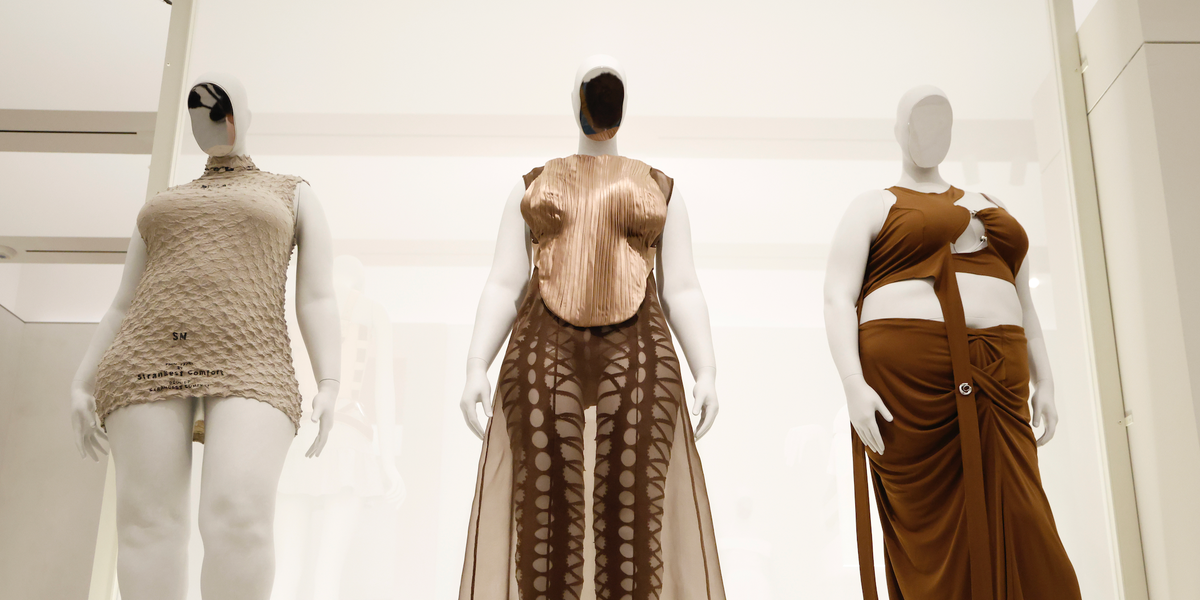
According to Harper's Bazaar, the mannequins anchoring Costume Art were built from 3D scans of real people — activists, musicians, models — representing a spectrum of sizes, shapes, and abilities. Among those scanned: disability activist Sinéad Burke, model Aariana Rose Philip, and musician Yseult. Consider that the standard retail mannequin runs a size 2, and the statement being made here becomes harder to dismiss as curatorial niceties. At a cultural moment when fashion's body-diversity commitments have largely evaporated amid the Ozempic era, a major institutional show built on actual human form is pointed.
The Artist Behind the Bodies
Brooklyn-based sculptor Frank Benson created the mannequins in collaboration with Bolton, designer Michaela Stark, and artist Samar Hejazi — using photogrammetry rigs, digital sculpting in ZBrush, and 3D printing to bring each figure to life. Benson's practice has long interrogated the human form; his hyperrealistic sculptures have appeared at the Met Breuer and the Whitney. For Costume Art, his team scanned subjects using a 175-camera rig at New York Capture in Brooklyn, then spent months digitally refining each figure — smoothing surfaces, defining extremities, carving practical dressing gaps — before sending approved files to fabricators. The full process, across 14 mannequins, took eight months. One figure presented a singular challenge: drag performer Goddess Bunny, who passed away in 2021, had to be sculpted entirely from photographs and archival material. Benson painted and assembled that mannequin entirely in-house.
The technical ambition served an artistic argument. Stark's mannequins, designed to display her corsetry work, capture the creases and soft compression of flesh under structured garments — something a standard form simply cannot hold. The body isn't backdrop here; it's the point. Benson describes the process as demanding "both technical precision and artistic sensibility simultaneously," and the results bear that out. His own history with inclusive representation — including mannequin heads sculpted for Telfar, shown across body types at the Berlin Biennale — threads directly into this commission.
Fashion has always been a language, and what Costume Art argues is that the body speaking it has been too long ignored, standardized, and edited down to a fiction — and that getting it right, finally, is the whole work.
Read the original at Harper's Bazaar.