The Story Behind Eileen Gu’s Bubble-Blowing Dress at the 2026 Met Gala
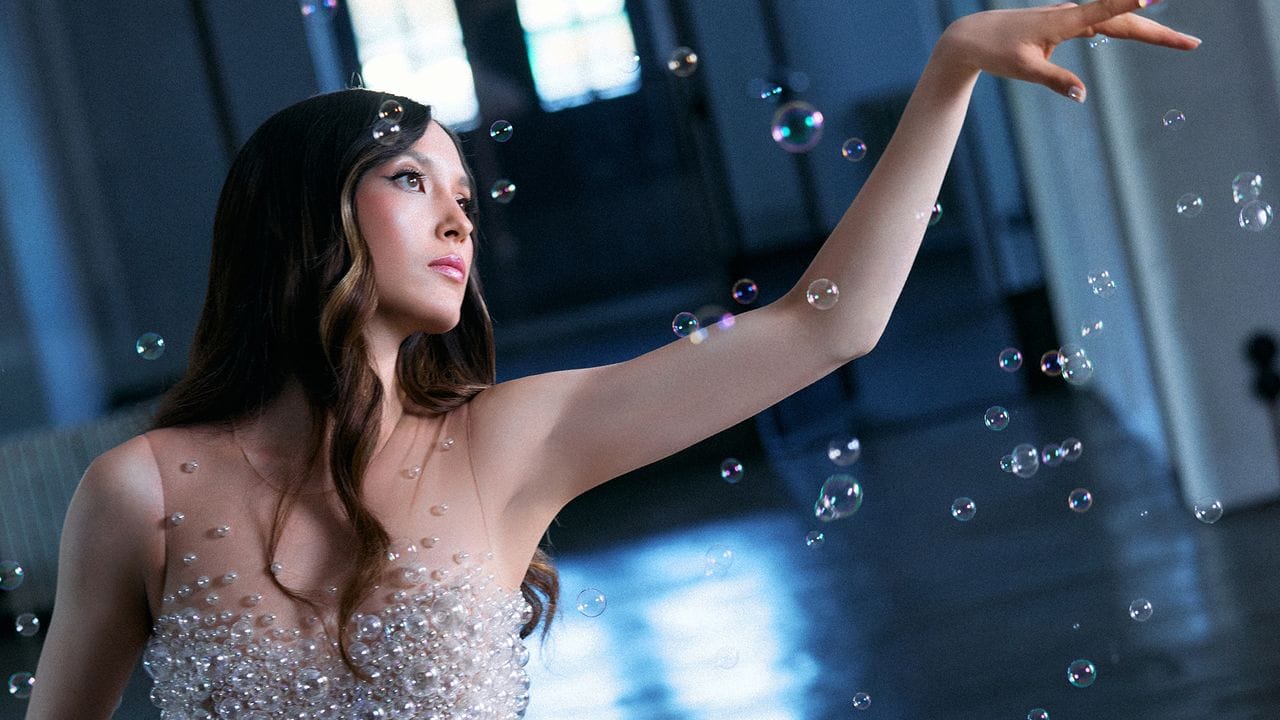
Olympian skier Eileen Gu captivated the 2026 Met Gala red carpet with a diaphanous dress seemingly constructed from bubbles. Designer Iris van Herpen and artists A.A Murakami break down the fantastical design.
Reported by Vogue.
The Met Gala's "Fashion Is Art" theme sent designers mining through centuries of creative history — Renaissance anatomy, Grecian draping, art movement nudes. Eileen Gu went further back than any of them. Her gown, conceived by Iris van Herpen in collaboration with Tokyo- and London-based artistic duo A.A. Murakami (Azusa Murakami and Alexander Groves), didn't reference art history so much as pre-history — specifically, the scientific theory that Earth's earliest life forms gestated inside microscopic bubbles called vesicles, protective membranes for pre-biological molecules where, according to some theorists, independent universes formed with their own cosmological rules.
Van Herpen translated that origin-of-life concept into something viscerally wearable. "99.9% of our body is empty space," the designer told Vogue. "When you think about that, it is so surreal." The resulting "Airo" dress is built from 15,000 hand-formed, individually bonded iridescent glass bubbles — and beneath its deceptively weightless silhouette lives a technical infrastructure of microprocessors, air pumps, bubble nozzles, and algorithmically engineered code that releases two to five real bubbles per second as the wearer moves. On the red carpet, Gu didn't just wear the dress. She exhaled it.
Engineering the Impossible
The collaboration required 15 weeks of development and 2,550 hours of work across couture, computational design, engineering, and science — making it one of the most complex constructions van Herpen's atelier has ever attempted. A.A. Murakami, whose practice spans the Venice Biennale and permanent collections at MoMA and the Centre Pompidou, worked alongside the IvH team to conceptualize and execute the look. Van Herpen, a trained ballerina, also had Gu's athletic body in mind: the dress was designed to echo the specific weightlessness of a freeskier mid-air, suspended between gravity and grace. "It takes her up into the air, and it embodies her airborne grace on the slopes," van Herpen said.
For Gu, the resonance went beyond spectacle. "It speaks deeply to me through themes of motion and stillness — being in the air, when time slows down," she said, connecting the dress's conceptual framework to both her sport and her identity. "Redefining what modern womanhood can look like in a traditionally male-dominated extreme sport" was part of what she saw the gown expressing. Van Herpen, who has dressed French world-champion skydiver Domitille Kiger for actual dives and built gowns from 25 million bioluminescent algae and fermented sugarcane biomaterials, has spent nearly two decades repositioning couture as a space where science belongs. Her first major U.S. retrospective, "Iris Van Herpen: Sculpting the Senses," opens at the Brooklyn Museum on May 16.
When fashion decides to take itself seriously as art, this is what it looks like — not a costume, but a cosmology you can wear.
Read the original at Vogue.

