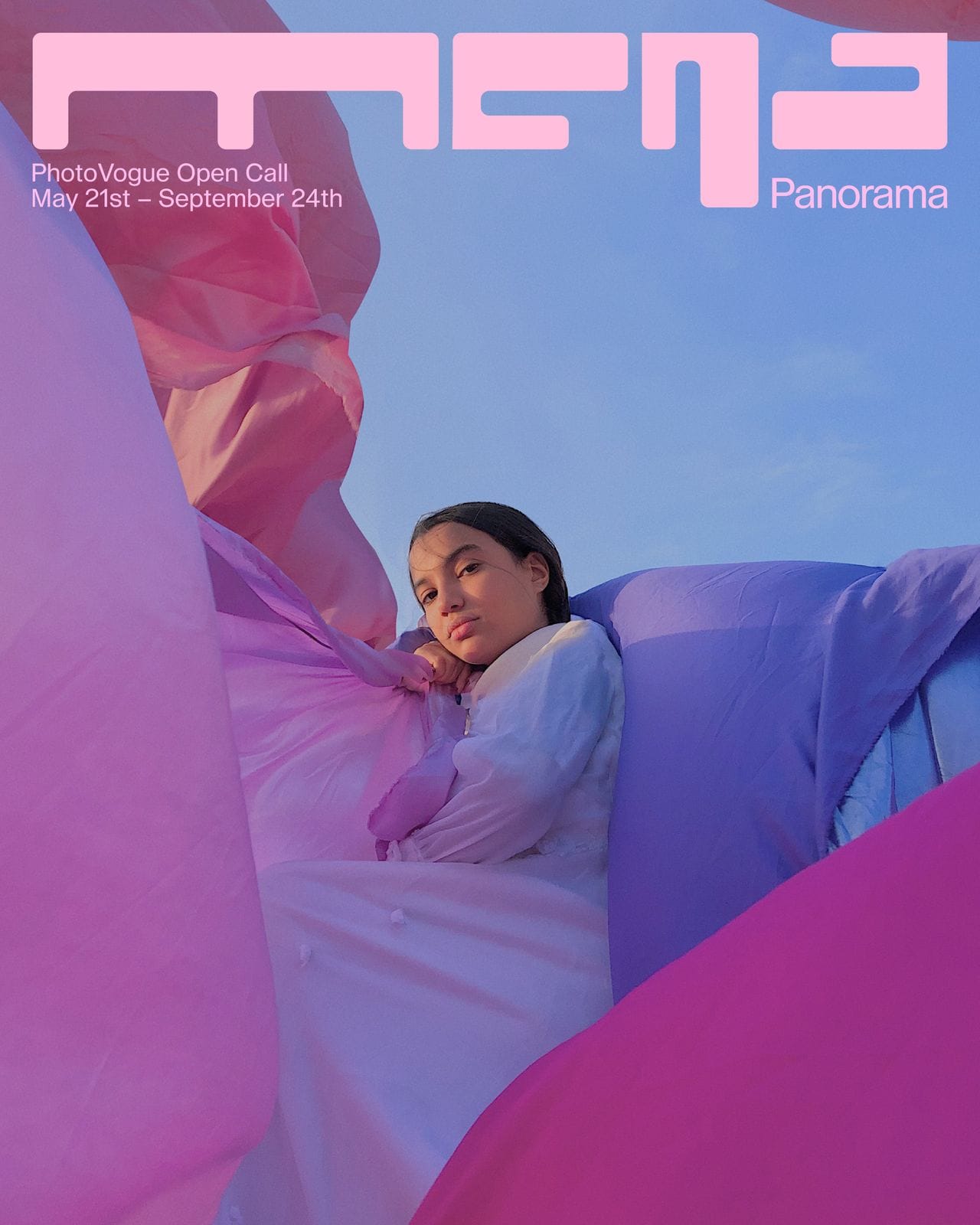
MENA Panorama: A Regional Open Call by PhotoVogue
A PhotoVogue Open Call for Image-Makers from Middle East and North Africa and Their Diasporas
Reported by Vogue.
The fashion image has long had a geography problem — certain regions rendered exotic, others erased entirely. PhotoVogue is making a deliberate move to correct that. MENA Panorama, the platform's latest regional open call, invites photographers, filmmakers, and multimedia artists from the Middle East, North Africa, and the diaspora to submit work on their own terms, with no predetermined narrative attached.
According to Vogue, the initiative follows previous regional calls covering Italy, Latin America, and East and Southeast Asia — and arrives at a moment when conflict, displacement, and social transformation are actively reshaping daily life across the MENA region. The call explicitly refuses to flatten that complexity. Fashion, documentary, portraiture, fine art, experimental practice — all of it is welcome, provided it carries a clear point of view and a visual language that's genuinely the artist's own.
What's Actually on the Table
The submission window runs May 21 to September 24, 2026, is free to enter via Picter, and is open to anyone 18 or older with a meaningful connection to the region. Artists can submit a series of up to 15 images, a multimedia combination, or a 60-second video trailer. Three grants totaling $8,000 will be awarded: a $4,500 Outstanding Vision Grant for work that pushes creative boundaries, a $2,000 Vision Grant for a strong and distinctive voice, and a $1,500 Rising Voice Grant for an emerging artist showing real originality. Beyond the money, selected work will be presented at the 2027 PhotoVogue Festival, with potential publication across Condé Nast titles including Vogue, GQ, Architectural Digest, and Condé Nast Traveler, plus access to PhotoVogue's Virtual Portfolio Reviews.
What makes this different from a generic open call is the framing. MENA Panorama isn't asking artists to explain their region to an outside audience — it's building infrastructure for self-representation, which is a meaningfully different ask. The kind of fashion and identity work that gets dismissed in Western editorial contexts as "too niche" is precisely what this platform is designed to hold.
If you have the work, this is the room worth walking into.
Read the original at Vogue.