Radical Botany and a Queer Gilded Age Are On View at The Alice Austen House
The show brings the work of little-known photographer Alice Austen together with that of Kara Walker and Linder
Reported by Harper's Bazaar.
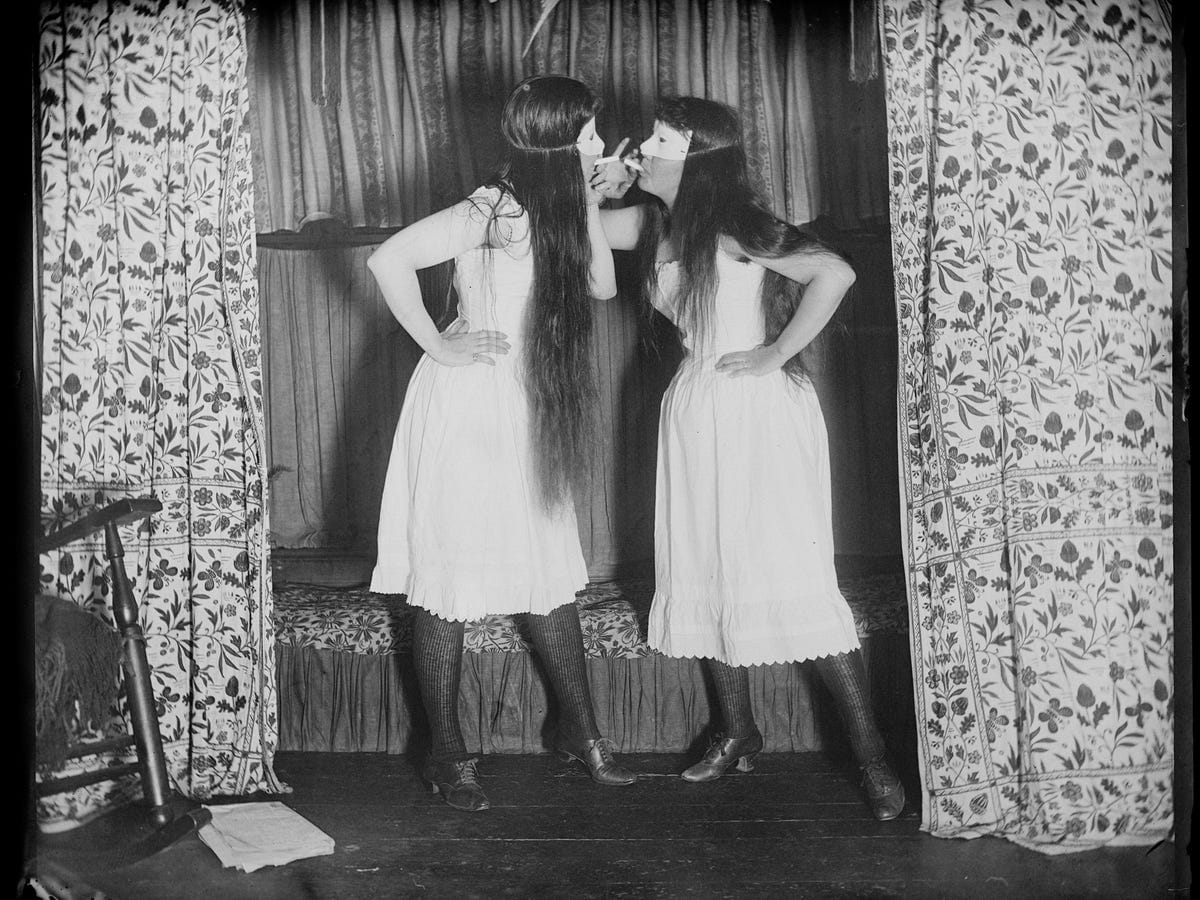
Alice Austen was doing iPhone-era photography before electricity was common. The Staten Island-born artist — self-taught, queer, relentlessly prolific — produced nearly 8,000 images across her lifetime, starting at age 10 when her uncle handed her a camera. She documented Gilded Age New York with photojournalistic precision: street vendors, the Statue of Liberty's dedication, immigrant labor. But the photographs that still hit hardest are the personal ones — her friends in bathing suits and drag, her neighbors on bicycles and in bed — made with equipment that could weigh upwards of 50 pounds, yet carrying the offhand warmth of a camera roll. Austen didn't hide her lesbianism or her decades-long partnership with Gertrude Tate. Victorian society didn't exactly celebrate that.
When the stock market crash wiped out their finances, Austen and Tate were evicted from their hilltop Staten Island cottage. Before she ended up in a farm colony, Austen donated her entire archive — a gesture of faith that wasn't fully rewarded. According to Harper's Bazaar, the Staten Island Historical Society preserved the work but suppressed its honest context. "This kind of closeting plus being a woman plus dying very impoverished meant that Alice has not been accepted into the canon," says Victoria Munro, executive director of The Alice Austen House, the National Historical Landmark that now occupies her childhood home.
The Garden as Resistance
Munro's programming strategy is deliberate revisionism — threading Austen's legacy through contemporary art that speaks her language. The current group exhibition, Radical Botany: The Politics of Flowers, co-curated by Dr. Susan Bright and Hedy Van Erp, does exactly that. Works by Pipilotti Rist, Kara Walker, Tracey Morgan, Justine Kurland, and others use flowers — wilting, arranged, decomposing, blooming — as entry points into gender politics, class, and race. "Flowers are often thought of as being purely decorative and pretty, but they are potent symbols of so much more," says Munro. Austen's own photographs are woven throughout.
Outside, the property's Queer Ecologies Garden — developed with the New York Restoration Project and Pratt students — pushes the conversation further. It's planted intentionally with species that are non-binary, self-seeding, and intersex, alongside symbolically queer plants like lavender and pansies. Wisteria grown there now hangs inside the Radical Botany show. Munro notes that historically, gardens were also spaces for queer cruising and connection — places where social rules softened. For Austen, the garden surrounding her cottage (once called "Clear Comfort") represented a rare pocket of autonomy. Munro notes that the history of female landscape designers skews heavily queer, and Austen — founder of the Staten Island Garden Club — fits that lineage exactly.
The house is quietly becoming a pilgrimage site for a new generation of queer visitors drawn to pre-Stonewall history and community, one ferry ride from Manhattan. The protest slogan that opens Radical Botany says it plainly: They tried to bury us, they didn't know we were seeds.
Austen spent her life making radical work in plain sight — the least we can do is look.
Read the original at Harper's Bazaar.