The Big Business of Marathons
Marathons have ballooned into an almost year-round opportunity for brands. Here’s how they’re capturing running share in 2026.
Reported by Vogue.
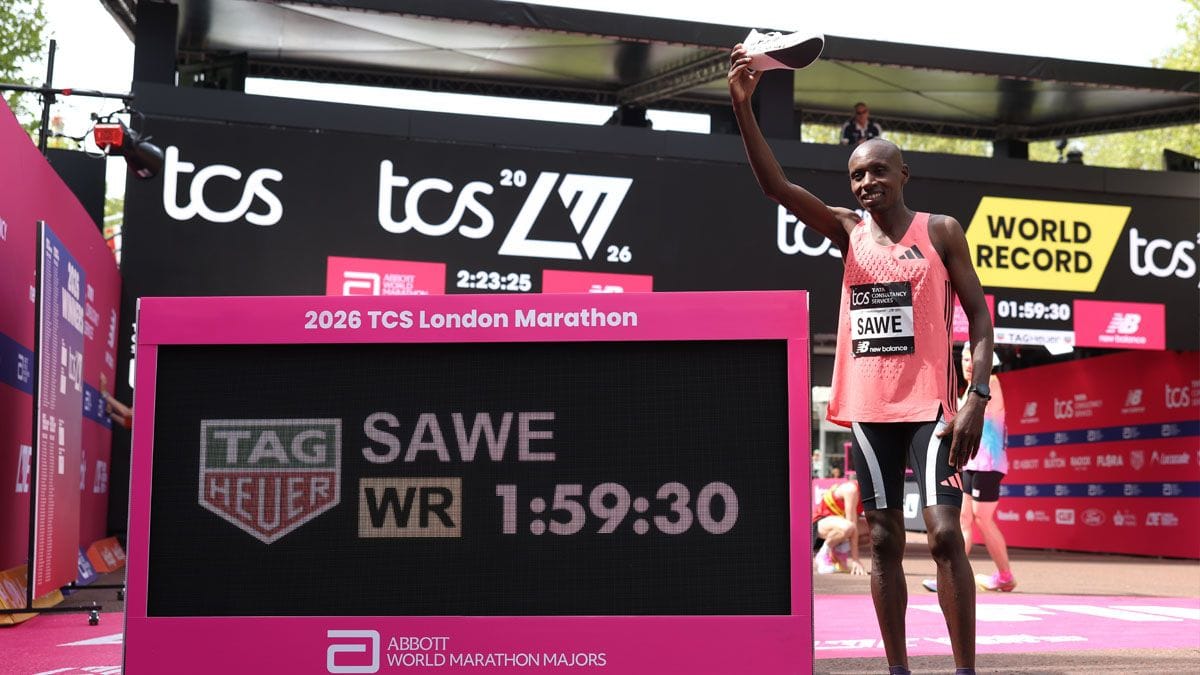
Two sub-two-hour marathons. One shoe. When Sabastian Sawe and Yomif Kejelcha both crushed the finish line at London's marathon last Sunday—with Sawe setting a world record of 1:59.30 and Tigist Assefa smashing the women's record at 2:15.41—they were all wearing the same piece of kit: Adidas's Pro Evo 3 supershoe. The moment generated $11 million in media impact value for the brand alone. But here's the thing: Adidas wasn't the only player on the pitch. Nike, On, Hoka, Puma, New Balance, and smaller names like Tracksmith and Satisfy all descended on London with pop-ups, experience hubs, and activation programs. The marathon weekend has officially become fashion's most competitive real estate.
The marathon boom is real. Ballot applications for London exceeded 1.13 million—up 36 percent year-on-year—with 59,830 runners crossing the finish line. The broader trend: World Marathon Majors applications across all seven cities are at an all-time high, according to Vogue. But the race isn't just about performance anymore. As Patrick Nava, general manager at Adidas Running, puts it: "The marathon has moved from being a single race day moment to a multi-layered cultural platform." It's now a convergence of elite sport, mass participation, and lifestyle storytelling. The rise of run clubs and the Harry Styles effect—yes, the singer ran Berlin and Tokyo marathons and landed a Runner's World cover—have transformed what was once a niche endurance event into a mainstream cultural moment that brands can't ignore.
The innovation flex
For performance brands, marathons function as credibility theaters. When On's LightSpray shoe carried Hellen Obiri to a Boston Marathon win in 2024, then to Olympic bronze and a New York course record in the same model, it proved that innovation translates to real-world dominance. Adidas leaned hard into this narrative at London: a limited 200-pair drop of the $500 Pro Evo 3 sold out instantly, with resale prices hitting $5,000 on StockX. The scarcity was intentional—the brand cited production constraints similar to F1 car manufacturing. But elements of that tech will filter into more accessible models soon, the brand promises. Nike, meanwhile, is "deeper into the prototype phase than it's ever been," according to global VP of running Tanya Hvizdak. The message from all camps is identical: marathons validate what happens in the lab.
What separates winners from also-rans, though, isn't just shoe engineering—it's cultural fluency. Tracksmith opened a pop-up on London's Chiltern Street and served pizza. Satisfy set up shop at Dover Street Market Paris. New Balance anchored its Run House at Somerset House, positioning itself as part of the spectator experience, not just the performance narrative. These brands understand that modern marathon culture includes casual runners, walkers, cheer crews, and Instagram-ready moments. Nike learned this the hard way when its Boston ad declaring "Runners welcome, walkers tolerated" tanked with audiences; Asics fired back with "Runners. Walkers. All welcome." The marathon isn't a performance test anymore. It's a lifestyle statement, and brands that treat it like anything less will get left at the starting line.
Read the original at Vogue.