What Makes an It Bag an It Bag?
Lore, scarcity, celebrity cosigns, and charisma all play a part
Reported by Harper's Bazaar.
Every decade has its status symbol, and for women, it's almost always a bag. Not just any bag — the bag. The one that signals you're in on something, whether that's downtown cool, old-money restraint, or boho abandon. But what actually makes an It bag? According to Harper's Bazaar, it's a precise alchemy of design, cultural timing, and the right shoulder to land on.
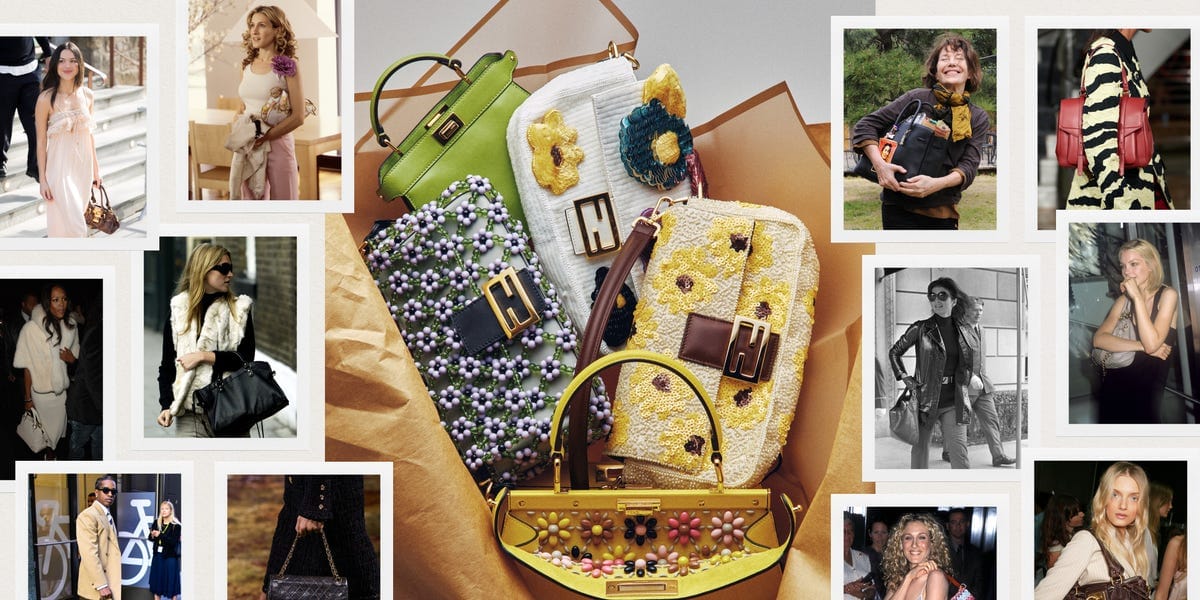
The origin story usually involves a visionary designer and an unexpected muse. The Fendi Baguette (1997), conceived by Silvia Venturini under Karl Lagerfeld, was born from the nonchalance of French women carrying bread — but it was Carrie Bradshaw who launched it into the stratosphere. Same goes for the Dior Saddle, John Galliano's 1999 equestrian fantasy that now fetches over $10K on Vestiaire Collective for rare editions. The Gucci Jackie has a longer lineage — originally the Constance (1961), renamed after Jackie Kennedy Onassis, then reimagined by Tom Ford in 1999 with a new geometric buckle, and now reworked again by Demna. Cultural gravity, across generations.
The Girls Who Made Them Famous
The Balenciaga Le City (2001), designed by Nicolas Ghesquière, became shorthand for early-aughts downtown energy — the kind of girl who leaves her bag on a bar floor without apology. Demna cemented its mythology with a 2024 campaign featuring Kate Moss and Amelia Gray. The Chloé Paddington (2005), Phoebe Philo's padlock-adorned boho masterpiece, found its early adopters in Sienna Miller and Lindsay Lohan; its metallic iterations are now having a full Depop renaissance, prompting creative director Chemena Kamali to reissue it. Meanwhile, the Marc Jacobs Stam — named after model Jessica Stam and carried by Rihanna and Paris Hilton — still inspires the kind of obsession that ends in a Poshmark deep-dive at midnight.
Then there are the bags that transcend trends entirely. The Chanel 2.55, named for its February 1955 inception date, gave wealthy women their first hands-free luxury moment. Karl Lagerfeld reissued it in the '70s, then again for its 50th anniversary — and now Matthieu Blazy just sent Coco Chanel's original flap down the runway, its leather worn and perfect. The Proenza PS1 (2008) carved out its own niche as the intellectual's It bag — sleek, nerdy, beloved by Serena van der Woodsen and the downtown art-world crowd — and new creative director Rachel Scott just debuted her own evolution, the Walker, slouchier and already covetable. And Phoebe Philo's Céline Phantom (2011), now reimagined by Michael Rider with an elongated silhouette and exaggerated zipper grin, proves that truly great design just keeps finding new reasons to exist.
An It bag isn't manufactured — it's earned, through the specific collision of a designer's instinct, a cultural moment, and the women who decided, without being told, that this was the one.
Read the original at Harper's Bazaar.